NPS Swasthya is a new framework under the National Pension System that brings retirement savings and healthcare support together. It combines a separate NPS Swasthya investment account with a super top-up health insurance policy.
The framework was introduced earlier under a regulatory sandbox. With the Pension Fund Regulatory and Development Authority (PFRDA) now issuing the Operational Guidelines for NPS Swasthya under NPS, 2026, Pension Funds can design and launch their Swasthya schemes, subject to the applicable guidelines and approvals.
For a subscriber, the idea is simple: build a dedicated retirement corpus while also having a healthcare protection layer that can become particularly useful as medical expenses rise with age.
What Is NPS Swasthya?
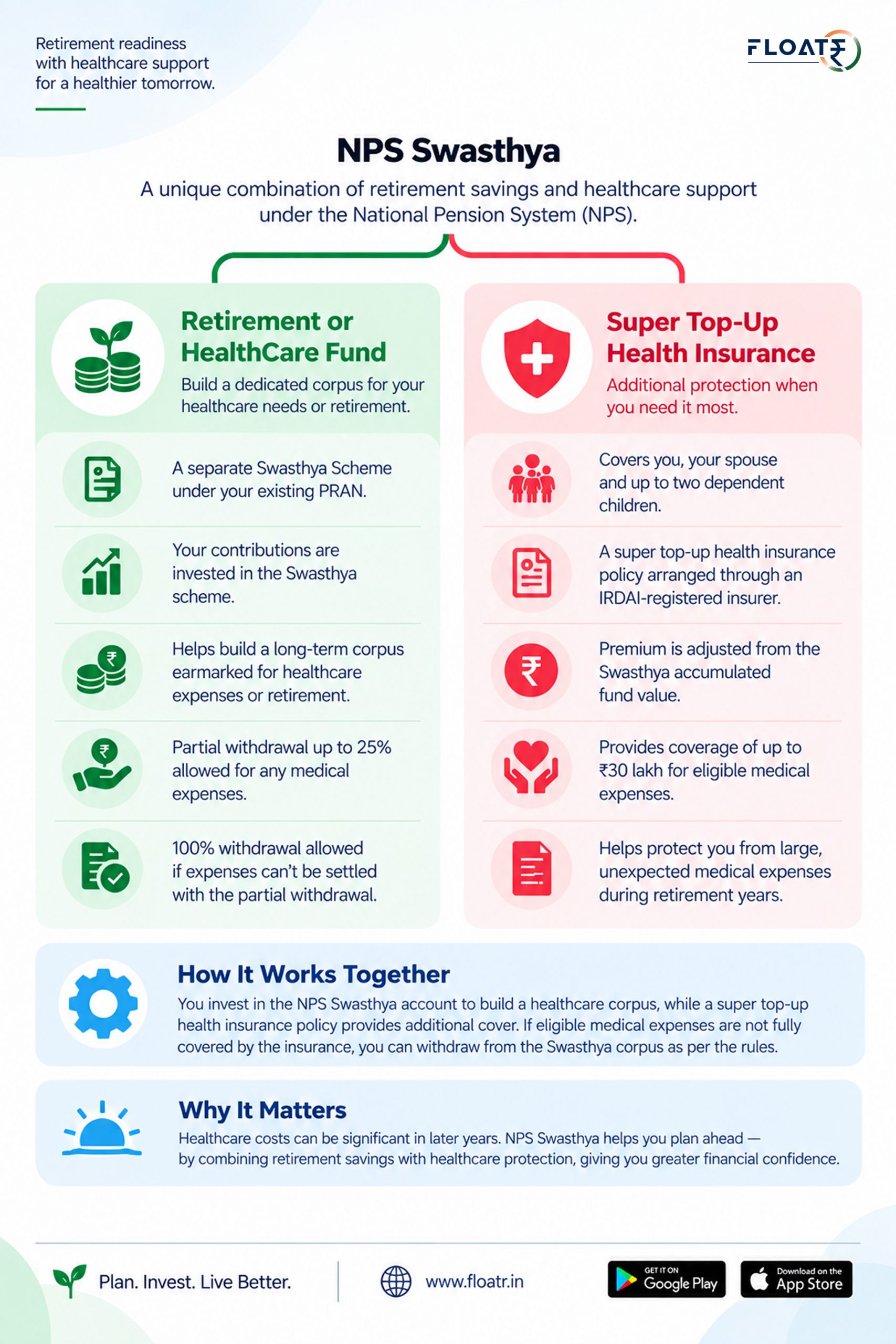
NPS Swasthya is a dedicated arrangement within NPS designed to help subscribers build a corpus for healthcare-related expenses while also providing a separate super top-up health insurance policy.
It has two distinct parts:
- An NPS Swasthya account where your money is invested.
- A separate super top-up health insurance policy arranged through an IRDAI-registered insurer.
These two parts are connected operationally, but they are legally and operationally separate. NPS Swasthya is governed on the NPS side by PFRDA, while the insurance component remains subject to insurance regulations.
Why Was NPS Swasthya Introduced?
Retirement planning is usually discussed in terms of building enough money for everyday living after retirement. Healthcare is another major expense that can become more important with age.
NPS Swasthya is designed to create a dedicated pool for eligible healthcare expenses while providing a health insurance layer. The objective is to give subscribers more flexibility when healthcare costs arise during later stages of life.
If you are building a broader retirement plan, healthcare planning is an important part of thinking about the income and expenses you may face after you stop working.
NPS Swasthya Combines Retirement Savings and Health Insurance
NPS Swasthya includes health insurance, but it is not simply a health insurance policy.
The insurance policy is a super top-up policy. Separately, the NPS Swasthya account builds an investment corpus. Eligible healthcare expenses that are not met by the insurance component may, subject to the rules, be considered for withdrawal from the Swasthya corpus.
This distinction is important because the insurance and the NPS account have different rules and functions. If you want to understand the broader role of NPS as a retirement product, you can also read our guide to Retail NPS.
Who Can Join NPS Swasthya?
Any individual between the age of 18 to 70 years can enrol in NPS Swasthya, subject to the guidelines.
The standard insurance arrangement provides family coverage for the subscriber, spouse and up to two dependent children. Parents are not included in the standard family coverage.
How Does NPS Swasthya Work?
Once you enrol, you have a separate NPS Swasthya account under your PRAN. Your contributions are invested in the Swasthya investment scheme.
At the same time, the associated super top-up health insurance policy provides healthcare protection based on its deductible, sum insured, waiting periods and other policy terms.
Once your enrolment is successfully completed and the required initial contribution is received, the insurance cover starts no later than the next working day.
The CRA maintains the Swasthya account and records contributions, units, NAV, withdrawals, insurance premium mandates, nominations and exit-related information.
If you are new to NPS, you may also want to understand the basics of the National Pension System before looking at how NPS Swasthya adds a healthcare layer.
NPS Swasthya Contribution: How Much Do You Need to Pay?
The first payment has three main components:
- The first-year insurance premium, including applicable taxes.
- ₹200 annual HBA maintenance charge, plus applicable taxes.
- At least ₹1,000 invested in the NPS Swasthya account.
After the initial contribution, the minimum subsequent contribution to the Swasthya account is ₹10.
How Is the NPS Swasthya Corpus Invested?
The money invested in the NPS Swasthya account follows the Central Government Scheme investment pattern under the applicable NPS investment guidelines.
This is a separate scheme account within NPS, so the Swasthya corpus can be tracked separately from your other NPS holdings.
NPS Swasthya Health Insurance: Understanding the ₹30 Lakh Cover
The NPS Swasthya framework provides different combinations of annual aggregate deductible and family-floater sum insured. The standard options specified in the guidelines are:
| Annual aggregate deductible | Family-floater sum insured |
|---|---|
| ₹10,000 | ₹1 lakh |
| ₹50,000 | ₹5 lakh |
| ₹1 lakh | ₹10 lakh |
| ₹3 lakh | ₹30 lakh |
The ₹30 lakh option therefore comes with a ₹3 lakh annual aggregate deductible. In simple terms, the deductible is the amount that needs to be met before the insurance cover starts paying eligible expenses under the policy, subject to the final policy wording.
The cover is a family floater for the subscriber, spouse and up to two dependent children.
Who Is Covered Under NPS Swasthya Health Insurance?
The standard family coverage includes the subscriber, spouse and up to two dependent children.
Parents are not included in the standard coverage.
The entry age for the insurance arrangement is 18 to 70 years, with renewal permitted up to age 85 subject to the applicable policy terms and law.
What Does NPS Swasthya Health Insurance Cover?
NPS Swasthya health insurance can cover inpatient hospitalisation, day-care procedures, domiciliary treatment, AYUSH treatment, prescribed modern treatments and eligible organ-donor expenses, subject to the final insurance policy wording.
The framework also specifies a single private room for normal hospitalisation and actual ICU expenses, subject to the sum insured and final policy terms.
Pre-hospitalisation expenses can be covered for 30 days and post-hospitalisation expenses for 60 days. Road ambulance is covered up to ₹2,500 per emergency hospitalisation unless a higher uniform limit is provided in the policy.
For a broader understanding of how health and other forms of protection fit into financial planning, see Floatr’s insurance solutions.
NPS Swasthya Waiting Periods and Pre-Existing Diseases
The NPS Swasthya waiting period is important to understand before enrolling, particularly if you already have a medical condition.
- A 30-day initial waiting period, except for accidents as provided in the policy.
- A 12-month waiting period for pre-existing diseases.
- A 12-month waiting period for specified diseases and procedures.
Controlled Type 2 diabetes, hypertension, hyperlipidaemia and asthma can be covered after the initial 12-month waiting period where the condition does not trigger enhanced underwriting, subject to the applicable policy terms.
You will also be required to provide a good-health declaration as part of the insurance process. Certain existing or past medical conditions may lead to enhanced underwriting or premium loading.
If cover is declined, the insurer must provide a specific reason. A decline for one family member does not automatically mean that all other eligible family members are excluded.
NPS Swasthya Withdrawal for Medical Expenses
One of the key features of NPS Swasthya is the ability to withdraw money for eligible medical and healthcare expenses.
You can withdraw up to 25% of the contributions you have made to the Swasthya account. There is no stated minimum waiting period and no limit on the number of eligible partial withdrawals.
The withdrawal is not paid to you as unrestricted cash. It is settled with the hospital, healthcare provider or other eligible entity in accordance with the framework.
Can You Transfer Existing NPS Money to NPS Swasthya?
A subscriber can transfer money from an existing All Citizen Model NPS account into NPS Swasthya, but only up to the amount needed to meet the applicable insurance deductible.
This does not mean that your entire existing NPS corpus can be moved into Swasthya.
What Happens When Medical Expenses Are Very Large?
NPS Swasthya has two layers that can work together: the insurance policy and the Swasthya corpus.
If an eligible inpatient healthcare expense in a single instance is higher than the amount that can be met through the partial-withdrawal route, the framework allows for a premature exit from the Swasthya account. The accumulated Swasthya corpus is first used for the eligible expense, and the remaining balance moves or merges into the All Citizen Model.
The insurance policy, if already in force, continues for the remaining policy period, i.e. till the end of the year for which the premium was already paid.
What Happens to the Insurance After a Major Medical Withdrawal?
Using the Swasthya corpus for an eligible healthcare expense does not automatically mean that the insurance policy ends. In the premature-exit situation described in the guidelines, the insurance policy continues for the remaining policy period.
NPS Swasthya Insurance Renewal: What Happens If You Cannot Pay?
The insurance premium needs to be paid at renewal for the cover to continue.
Where practicable, subscribers can receive alerts around 90, 60 and 30 days before renewal if the available Swasthya balance may not be sufficient. If the premium is not funded and the policy lapses after the applicable grace period, the Swasthya account is closed and moved or changed to the All Citizen Model as provided in the framework.
Can You Change Your NPS Swasthya Scheme?
A scheme change is permitted at the time of insurance renewal. Depending on the product, this can involve a change in Pension Fund and associated insurer, while applicable continuity rules for the insurance cover need to be followed.
What Happens to NPS Swasthya at Retirement?
NPS Swasthya follows the applicable NPS exit rules for normal exit and death. The Swasthya account is closed at the relevant exit event, and the treatment of the accumulated corpus follows the rules applicable to non-government subscribers.
The bigger idea is that the healthcare-focused corpus and insurance protection are intended to support expenses that can become more significant during retirement.
From Sandbox to the Official NPS Swasthya Framework
NPS Swasthya was first tested under PFRDA’s regulatory sandbox framework. The September 2026 operational guidelines now provide the framework for regular NPS Swasthya schemes.
Existing subscribers under the earlier sandbox arrangements are to be given an option to migrate to the new framework or merge into the All Citizen Model, with the relevant Pension Fund, CRA and other intermediaries facilitating continuity.
Who Manages NPS Swasthya?
Pension Fund
The Pension Fund designs, implements and administers the Swasthya scheme in accordance with PFRDA’s guidelines and approvals. It also selects the Health Benefit Administrator and the insurer for its scheme.
Health Benefit Administrator
The Health Benefit Administrator, or HBA, is the healthcare facilitation layer. It helps with healthcare eligibility checks, withdrawal processing, digital coordination, status updates and the healthcare journey.
Insurance Company
The insurance component must be provided through an insurer registered with IRDAI. The insurance policy is separate from the NPS account.
TPA
The Third Party Administrator, or TPA, supports the insurance claims and healthcare service process as specified by the insurer and policy.
CRA
The Central Recordkeeping Agency maintains the NPS Swasthya account under your PRAN and records contributions, investments, withdrawals, premium mandates, nominations and exits.
How Does the NPS Swasthya Health Insurance Claim Process Work?
The framework sets service standards for the healthcare and insurance journey. For example, cashless pre-authorisation is expected within one working hour of receiving a complete request, while final discharge authorisation is expected within three hours.
The HBA is also required to provide referral and status updates within specified timelines. Reimbursement claims have a target of 15 calendar days from receipt of the last necessary document, subject to the applicable IRDAI framework.
These are service standards and targets under the framework, not a guarantee that every individual claim will be settled within the same time.
What Should You Check Before Choosing an NPS Swasthya Plan?
Before enrolling, look beyond the headline ₹30 lakh figure and understand the actual insurance product being offered.
- Sum insured and deductible: understand how much insurance is available and what amount you need to meet before the cover applies.
- Premium: the actual premium will depend on the Swasthya plan launched by the Pension Fund.
- Family coverage: the standard arrangement covers the subscriber, spouse and up to two dependent children; parents are not included.
- Waiting periods: check the initial, pre-existing disease and specified disease or procedure waiting periods.
- Renewal: understand how the renewal premium is determined and how it will be funded.
- Medical withdrawal: understand how much of your own contribution can be used for eligible healthcare expenses and how the payment is made.
- Major medical expenses: understand how the deductible, insurance cover and Swasthya corpus work together.
NPS Swasthya vs Standalone Super Top-Up Health Insurance
The actual premium for NPS Swasthya will only be known once the Pension Funds launch their respective Swasthya plans. So, any comparison at this stage is only an illustration.
For example, suppose a standalone super top-up policy from a health insurance company for a four-member family costs around ₹15,000 a year, with a ₹3 lakh deductible and ₹30 lakh sum insured.
If we assume, purely for illustration, that the Swasthya insurance premium is ₹8,000 a year, the initial payment could look something like this:
| Component | Amount |
|---|---|
| Insurance premium | ₹8,000 |
| HBA administrative charge | ₹200 |
| GST on administrative charge | ₹36 |
| Minimum NPS contribution | ₹1,000 |
| Total initial payment | ₹9,236 |
The important point is that ₹8,000 is an assumed premium, not the confirmed Swasthya premium. The actual cost will depend on the insurance plan launched by the Pension Fund.
The proposed structure also envisages an automated mechanism through which future insurance premiums could be paid from the returns generated by the growing NPS Swasthya corpus, subject to the final product and operational framework. This is a mechanism that resembles a unit-linked insurance plan (ULIP).
So the real comparison should ultimately be made on premium, deductible, coverage, waiting periods, exclusions and the value of the NPS corpus, rather than premium alone.
Why NPS Swasthya Could Matter in Old Age
Healthcare costs can become a larger part of household expenses as people get older. At the same time, income after retirement may become more dependent on accumulated savings and pension income.
NPS Swasthya brings these two retirement concerns together. It allows a subscriber to build a dedicated healthcare-oriented corpus while also having a super top-up insurance layer.
The insurance can help with large eligible hospitalisation expenses after the applicable deductible, while the Swasthya corpus can provide another source for eligible healthcare expenses under the withdrawal rules.
For someone planning for retirement, this can make healthcare planning part of the retirement conversation rather than something considered only when a medical emergency occurs.
NPS Swasthya Is More Than ₹30 Lakh of Health Insurance
The headline figure of ₹30 lakh is likely to attract attention, but the real concept is broader. NPS Swasthya combines retirement savings, a healthcare-focused corpus and a super top-up insurance policy.
The final products launched by Pension Funds will determine the actual premium, product features and customer experience. Subscribers should therefore compare the final policy terms rather than looking at the headline sum insured alone.
As these products become available, NPS Swasthya could add a new dimension to retirement planning: preparing not only for how you will fund your life after retirement, but also for how you will meet healthcare expenses when you are older.
Frequently Asked Questions About NPS Swasthya
1. What is NPS Swasthya and how does it work?
NPS Swasthya combines a dedicated NPS investment account with a separate super top-up health insurance policy. Your contributions build the Swasthya corpus, while the associated insurance provides healthcare protection based on its deductible, sum insured and policy terms. You can also read our guide on Retail NPS to understand the broader NPS framework.
2. What are the benefits of NPS Swasthya?
It is designed to combine retirement savings with healthcare planning. It provides a dedicated corpus for eligible healthcare expenses and a separate super top-up insurance layer. For the broader role of NPS in retirement planning, see Floatr’s guide to retirement planning.
3. Is NPS Swasthya a health insurance policy?
No. NPS Swasthya includes a separate super top-up health insurance policy, but the NPS Swasthya account and insurance policy are legally and operationally distinct. The insurance component is arranged through an IRDAI-registered insurer.
4. How much health insurance is available under NPS Swasthya?
The standard framework provides family-floater options up to ₹30 lakh of sum insured. The ₹30 lakh option has a ₹3 lakh annual aggregate deductible.
5. How much can I withdraw from NPS Swasthya for medical expenses?
You can withdraw up to 25% of the contributions you have made to the Swasthya account for eligible healthcare expenses, subject to the applicable rules. There is no stated limit on the number of eligible partial withdrawals.
6. Are parents covered under NPS Swasthya?
Parents are not included in the standard family coverage. The standard arrangement covers the subscriber, spouse and up to two dependent children. If you are evaluating separate health protection for your family, you can explore Floatr’s health insurance solutions.
7. What is the NPS Swasthya insurance premium?
The final premium will be known only after Pension Funds launch their respective Swasthya products. Premiums will depend on the insurance plan and applicable insurance terms. The ₹8,000 example in this article is only an illustration and should not be treated as the actual Swasthya premium.
8. Can I transfer my existing NPS money to NPS Swasthya?
Yes, but the framework limits the transfer from an existing All Citizen Model NPS account to the amount needed to meet the applicable insurance deductible.
9. What happens if I cannot pay the NPS Swasthya renewal premium?
If the renewal premium is not funded and the policy lapses after the applicable grace period, the Swasthya account is closed and moved or changed to the All Citizen Model as provided in the framework.
10. What is the difference between NPS and NPS Swasthya?
NPS is the broader retirement savings framework. NPS Swasthya is a specific NPS arrangement that adds a healthcare-focused investment account and a separate super top-up health insurance policy.
Source: Pension Fund Regulatory and Development Authority (PFRDA), Operational Guidelines for NPS Swasthya under the National Pension System (NPS), 2026, Circular dated 18 September 2026.