Retirement Planning in India – Build Future Income Before You Need It
Create financial freedom for later life through disciplined planning, long-term investing and smart income strategies.
Most people don’t retire because they stop working. They retire because they have enough income without working. Floatr helps you estimate future needs, calculate monthly investing goals and build a retirement roadmap with confidence.
 Future incomeSIP + NPSPlan early
Retirement Is Not an Age. It Is an Income Question.
Many people think retirement starts at 60. In reality, retirement starts when your investments can support your lifestyle.
The real retirement date is when your money can work harder than you do.
Because Time Passes Faster Than Most Plans
Retirement problems usually begin years before retirement day.
 Time fliesCosts rise
Why plans fall behind
Retirement problems usually begin years before retirement day.
₹1 Lakh Monthly Today May Not Feel Like ₹1 Lakh Later
Example at 6% inflation — future lifestyle costs rise quietly.
Today’s ₹1L/month
Same lifestyle target
Long-horizon planning
What this means: Future retirement income needs are often underestimated.
Retirement gets expensive quietly.
Start With Lifestyle, Not Random Numbers
Desired retirement income today = ₹1,00,000/month. In 30 years, inflation-adjusted need may be much higher — often requiring a multi-crore corpus.

A retirement target should be calculated, not guessed.
Small Discipline Can Create Large Freedom
Many retirements are built through ordinary monthly habits — not one lucky year.
Potential corpus
₹3.5 Crore+
Potential corpus
₹7 Crore+
Potential corpus
₹5.1 Crore+
Same habit, different monthly amount — compounding does the heavy lifting over decades.
Many retirements are built through ordinary monthly habits.
Illustrative only. Returns not guaranteed.
Time Can Lower Your Monthly Burden Dramatically
Monthly SIP needed changes sharply with how many years you have left to invest.
30 years left
₹16,000
monthly SIP
Time does most of the work
25 years left
₹29,000
monthly SIP
Still manageable with discipline
20 years left
₹52,000
monthly SIP
Catch-up mode kicks in
15 years left
₹95,000
monthly SIP
Nearly 6× the 30-year path
Starting earlier can reduce monthly pressure more than chasing higher returns later.
What this means: Delay often costs more than poor returns.
Time is the most valuable retirement asset.
Retirement Planning vs Just Saving Money
They are not the same thing — one stores value, the other creates future income.
Saving Only
Retirement Planning
Saving money stores value. Retirement planning creates income.
Build Retirement Through Multiple Engines
One future may need more than one tool — growth, stability and tax efficiency together.
NPS
Tax-efficient, retirement-focused accumulation with disciplined lock-in.
Mutual Funds
Long-term growth potential through diversified SIP investing.
PPF
Conservative stability route for a portion of the portfolio.
EPF / Employer Benefits
Useful foundation layer — especially for salaried professionals.
Gold / Diversifiers
Supplementary allocation for balance across market cycles.
One future may need more than one tool.
Retirement May Last 25 to 35 Years
Retire at 60, live till 85–95 — income may be needed for decades, not months.
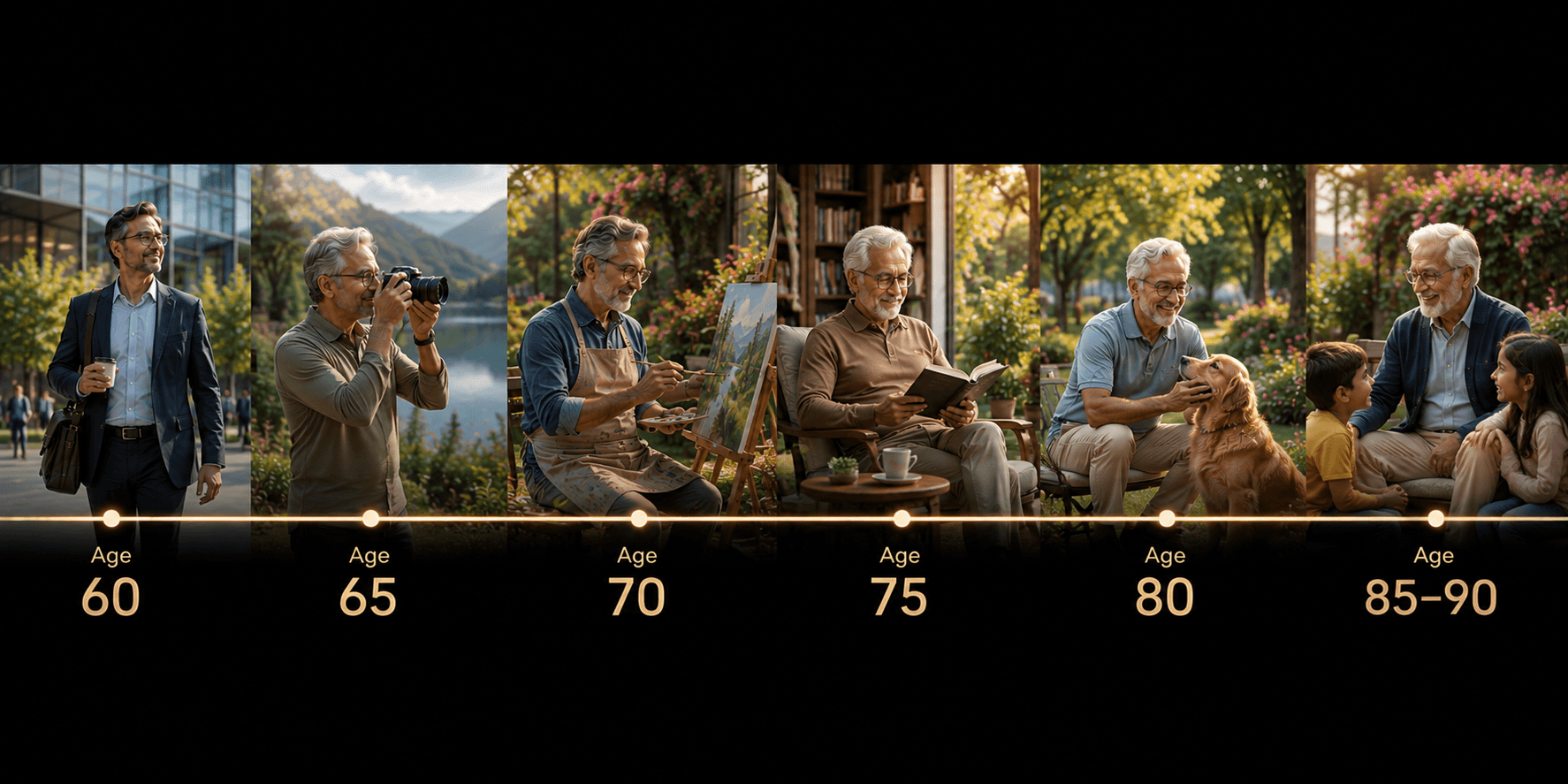
Retirement begins
Salary stops — your corpus must start funding monthly lifestyle.
Years 1–10Healthcare rises
Medical and support costs often accelerate — buffer matters.
Years 11–20Longevity risk
Income may still be needed — plan for the full third of life, not just launch.
Years 21–35If you retire at 60 and live till 85–95, withdrawals may continue for 25–35 years.
Retirement is not one day. It can be a third of life.
Avoid These Costly Errors
Retirement mistakes compound too — in rupees and in peace of mind.
These errors rarely show up on a statement — they show up as smaller corpus and less monthly freedom later.
Starting too late
Every year delayed can push required monthly SIP sharply higher — often harder than earning 2% extra return.
High impactIgnoring inflation
₹1 lakh lifestyle today may need multiples later — corpus targets must rise with future expenses.
UnderestimatedKeeping money idle
Parking long-term savings only in low-return accounts while inflation quietly erodes purchasing power.
CommonNo growth assets
Avoiding equity or growth funds for decades — corpus may not keep pace with rising needs.
Growth gapNo withdrawal plan
Building corpus without SWP or income strategy — risk of running out or overspending early.
At retirementStopping SIPs early
Pausing investments years before retirement cuts compounding when it matters most.
Compounding lossUnderestimating medical costs
Healthcare often accelerates after 70 — buffers and insurance should be part of the retirement plan, not an afterthought.
Later-life riskRetirement mistakes compound too.
Every Age Has a Different Advantage
Every decade has a strategy. None should be ignored.
Maximum time advantage — small SIPs can become large corpuses.
Strong earning years — align raises with automatic step-up SIPs.
Focused acceleration — catch-up contributions and clear corpus targets.
Optimization + income planning — shift from pure accumulation to withdrawal readiness.
Build your own pension path — NPS, SIPs and disciplined provisioning.
Every decade has a strategy. None should be ignored.
Simple Numbers. Practical Direction.
Retirement confidence grows when uncertainty shrinks.
Retirement confidence grows when uncertainty shrinks.
What Starting Today Can Mean
Future freedom is often purchased monthly — illustrative compounding @ 12%.

₹5,000 / month
20 years → ₹49 Lakhs
30 yrs → ₹1.76 Cr
₹10,000 / month
20 years → ₹99 Lakhs
30 yrs → ₹3.5 Cr
₹20,000 / month
20 years → ₹1.98 Cr
30 yrs → ₹7 Cr
Illustrative compounding estimates.
Future freedom is often purchased monthly.
Plan the Years When You Want Choice
Use Floatr Retirement Planning to estimate your corpus, monthly contribution needs and future income confidence.