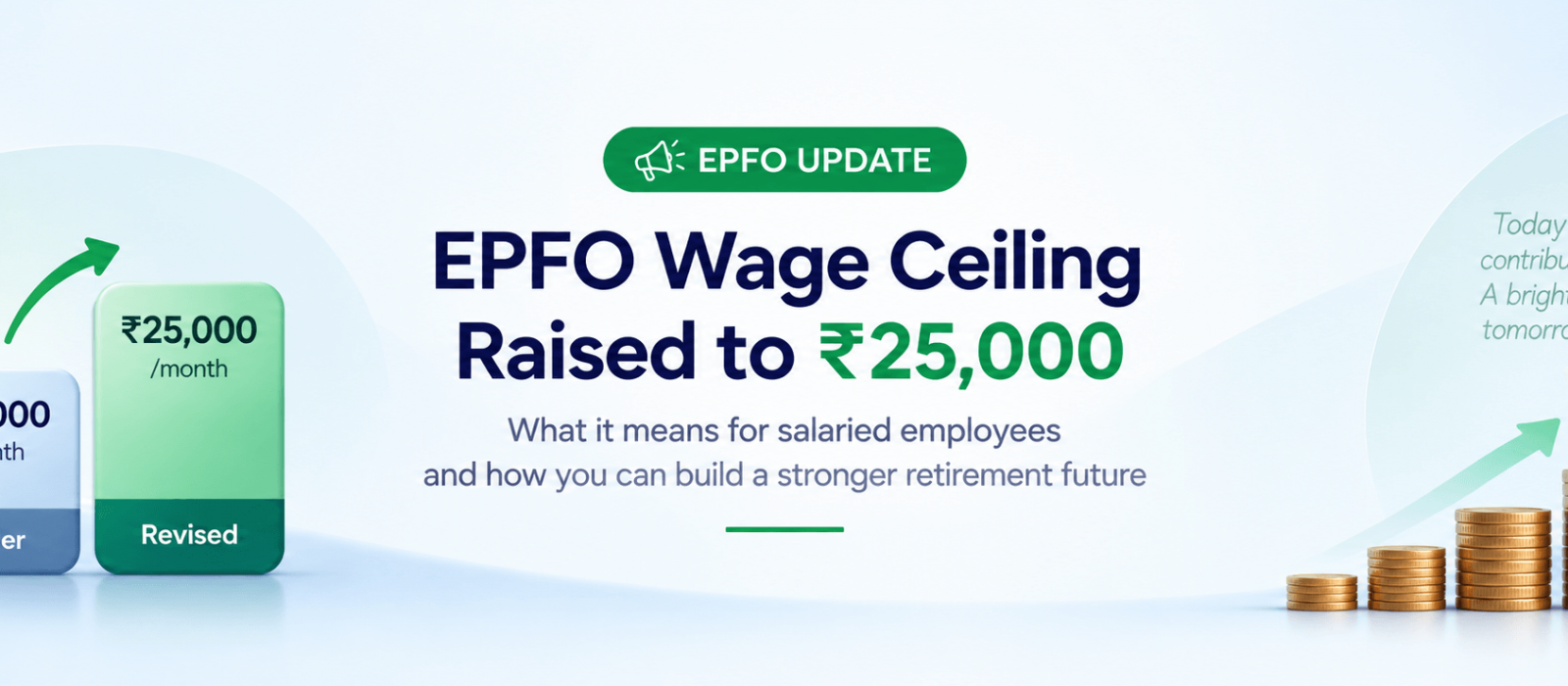
The Union Cabinet has approved an increase in the wage ceiling for mandatory EPFO coverage from ₹15,000 to ₹25,000 per month. The change, approved on 16 September 2026, is expected to bring more than 51 lakh additional employees into mandatory EPFO coverage.
For employees, this is more than a change in a number. It expands access to EPF savings, pension protection under the Employees’ Pension Scheme (EPS) and insurance protection under the Employees’ Deposit Linked Insurance Scheme (EDLI). The government has said the move is intended to bring the formal social-security framework closer to today’s wage levels, with the previous ceiling having remained at ₹15,000 since 2014.
But there is another way to look at this change. Higher retirement contributions today can mean a larger retirement corpus tomorrow. And for employers, it may also be a good time to look at how EPF and Corporate NPS can work together.
What has changed in EPFO?
The mandatory EPFO wage ceiling has moved from ₹15,000 to ₹25,000 per month.
This particularly matters for employees earning between ₹15,000 and ₹25,000 who were previously outside mandatory EPFO coverage because their wages exceeded the old threshold. They are now expected to come within the statutory social-security framework, subject to the applicable provisions and implementation process.
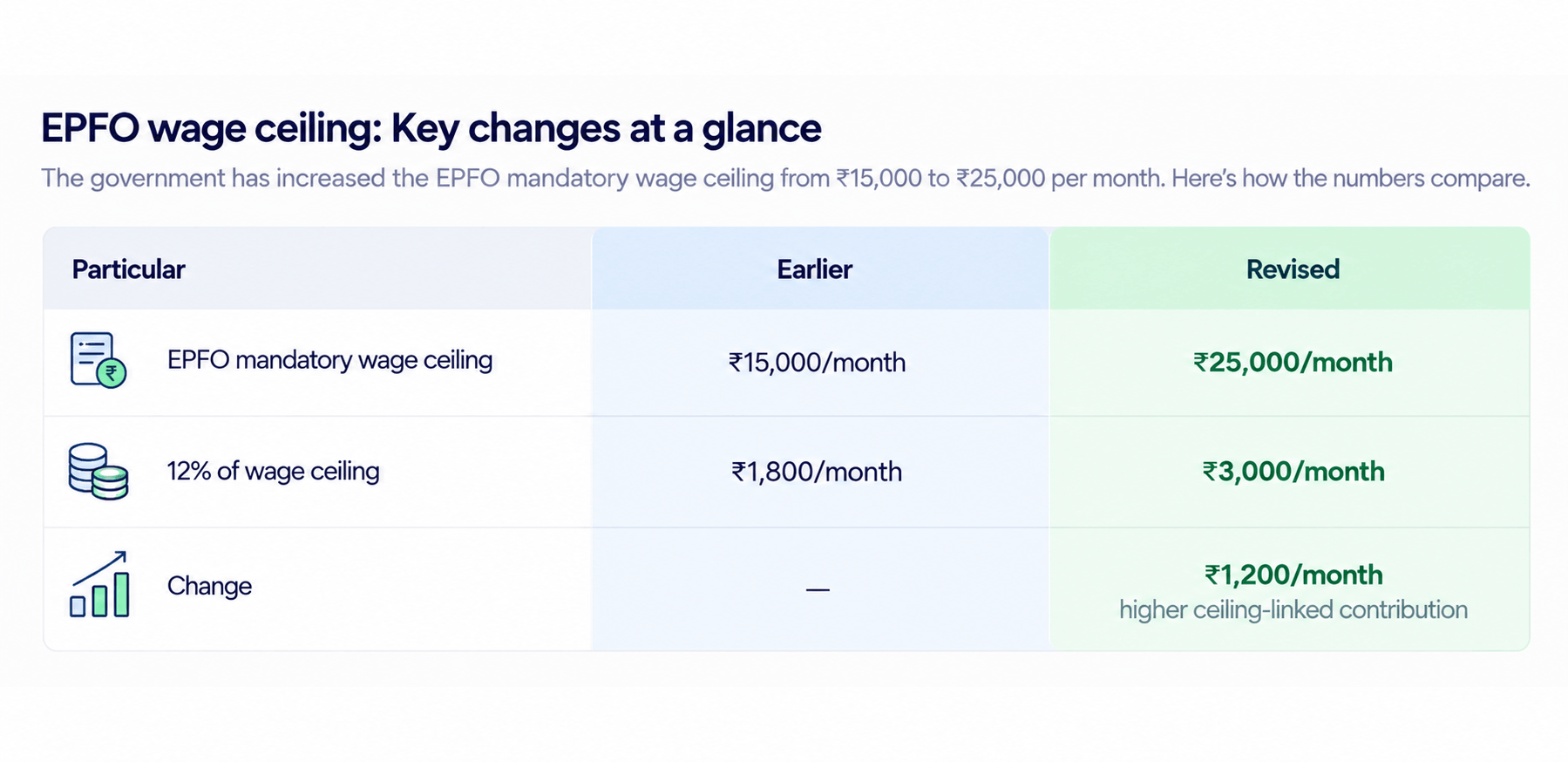
The revised ceiling also increases the wage base relevant to statutory contributions where the ceiling is applied. Financial Express reports that the pension contribution cap under EPS would correspondingly rise from ₹1,250 to ₹2,082 per month.
However, employees should not assume that everyone currently earning above ₹25,000 will automatically see their EPF contribution become ₹3,000. The announcement primarily changes the mandatory coverage ceiling, while the actual contribution structure will depend on the applicable EPF provisions and the employer’s arrangement.
What does this mean for salaried employees?
For employees newly brought under mandatory EPFO coverage, the immediate benefit is greater access to structured retirement savings and associated social-security benefits.
For someone who contributes more towards EPF over a long career, the impact is not limited to the additional amount saved each month. The larger contribution also gets more time to compound.
That is important because retirement savings are one area where time can matter as much as the amount invested.
An additional ₹1,200 a month may not look significant when viewed in isolation. But over several decades, regular contributions and compounding can turn relatively small monthly amounts into a meaningful retirement corpus.
The government estimates that the change will bring more than 51 lakh additional employees under mandatory EPFO coverage, strengthening formal retirement and social-security participation.
But this also raises a larger retirement-planning question
A higher EPF contribution is useful. But retirement planning should not necessarily stop with EPF.
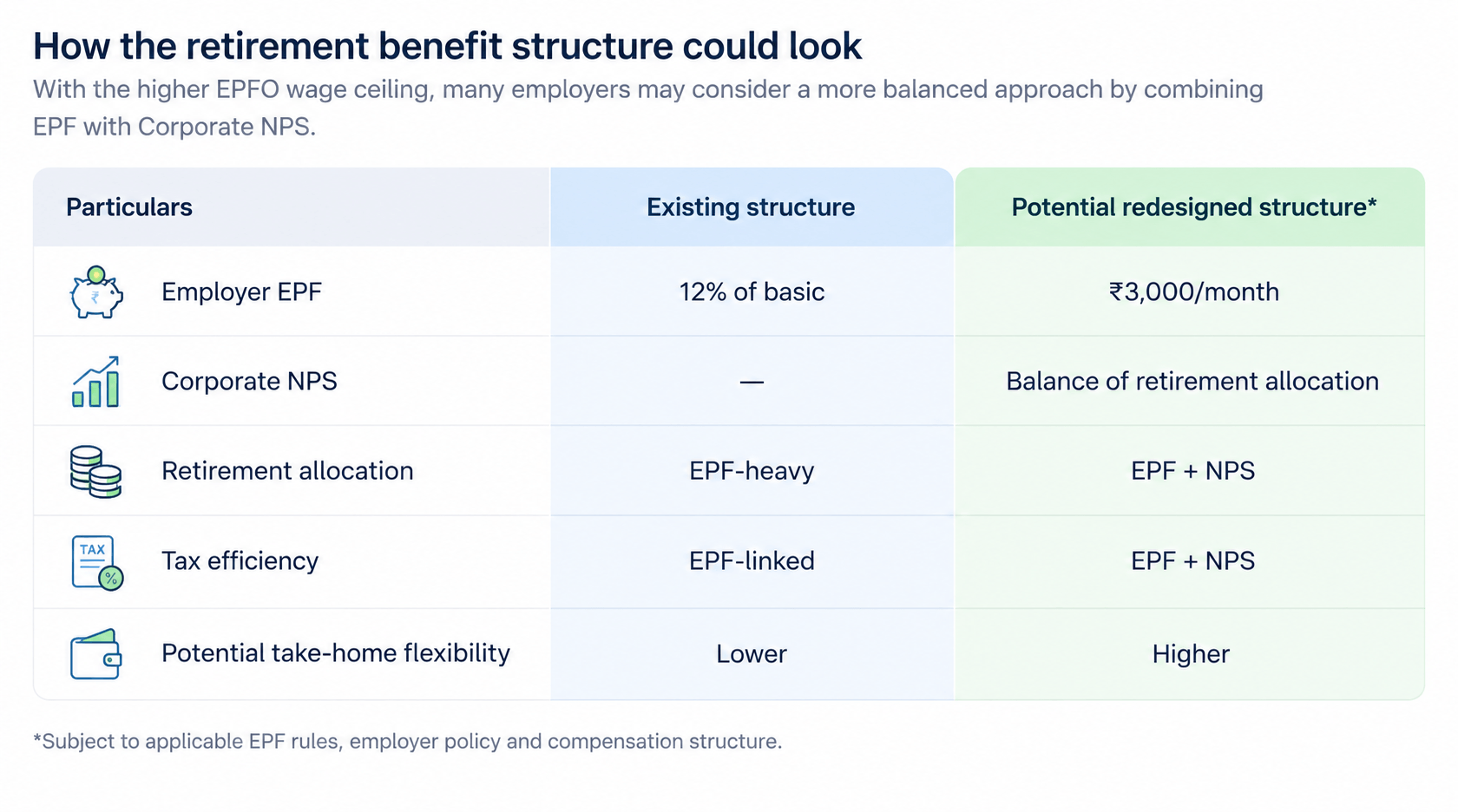
For employers that currently contribute 12% of actual basic salary towards EPF, the revised ceiling also creates an opportunity to examine whether the retirement benefit structure can be redesigned.
For example, where the applicable rules and employer policy permit EPF contributions to be limited to the revised statutory wage ceiling, an employee with a basic salary significantly above ₹25,000 could have the employer contribution structured around the ₹3,000 monthly statutory amount, with the balance of the retirement-benefit allocation directed towards Corporate NPS.
This is where EPF and NPS can complement each other.
EPF + Corporate NPS: a different retirement architecture
Suppose an employer currently contributes 12% of an employee’s basic salary to EPF.
Instead of putting the entire employer retirement contribution into EPF, the organisation could, where permitted and appropriately structured, consider a combination of:
- EPF for the statutory retirement foundation
- Corporate NPS for additional retirement accumulation
Corporate NPS can provide an additional tax-efficient retirement investment route for eligible employees, while allowing the employer to allocate part of the retirement benefit towards a market-linked pension investment.
The advantage is not simply about increasing retirement savings.
It can potentially create three outcomes at the same time:
- Higher retirement investment: potentially larger retirement corpus
- Corporate NPS contribution: additional tax efficiency
- Optimised EPF contribution structure: potential increase in take-home pay
The additional take-home salary, where created through a redesigned compensation structure, can then be directed towards other financial goals such as children’s education, home purchase, emergency funds or additional investments.
That makes the discussion much broader than simply “EPF versus NPS.” It is about designing the right mix of retirement savings and present-day financial flexibility.
The bigger opportunity for employers
The increase in the EPFO wage ceiling is ultimately a reminder that retirement benefits need to evolve with employee incomes.
The old ₹15,000 ceiling was set in 2014. Since then, wages have risen, formal employment has expanded and the financial needs of employees have changed. The government itself has cited sustained wage growth and rising incomes as reasons for revising the ceiling.
For employers, therefore, this could be more than a payroll change.
It could be an opportunity to ask a larger question:
Are we simply contributing towards retirement, or are we actually designing a retirement architecture for our employees?
EPF can remain the foundation. Corporate NPS can add another layer of retirement accumulation and tax efficiency. And better-designed compensation can give employees greater flexibility to address their other financial goals.
The real value of retirement planning is not just the amount accumulated at retirement. It is the financial choices that the corpus enables when that day finally arrives.