The Multiple Scheme Framework (MSF) changed the way non-government subscribers can invest in the National Pension System (NPS). Instead of choosing just one scheme, investors can now select multiple schemes and diversify across Pension Fund Managers (PFMs).
But greater choice also created a new challenge.
As PFMs started launching multiple NPS MSF schemes, each came with its own name and investment positioning. For an investor, it was not always easy to understand whether two schemes from different PFMs were actually comparable.
PFRDA has now introduced a standardised framework for NPS scheme classification and naming. For investors, the objective is simple: make NPS schemes easier to understand and compare.
What are the new MSF scheme categories?
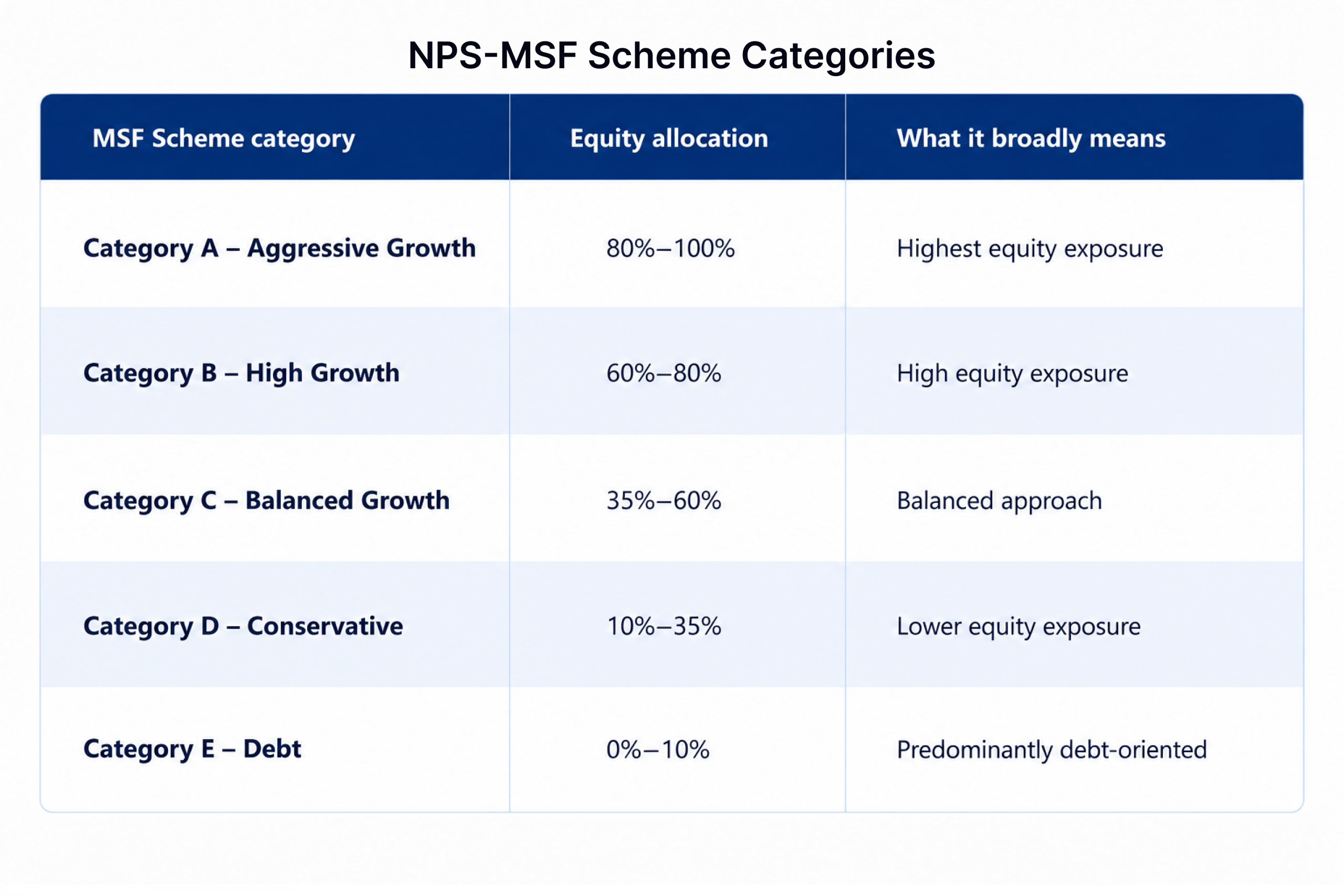
Under the new framework, MSF schemes will be classified into five categories based on their permitted equity allocation.
This gives investors an immediate understanding of the broad NPS investment, strategy and equity exposure of a scheme.
For example, someone looking for a high-growth portfolio can begin by looking at Category A or B. An investor looking for a more balanced approach can consider Category C, while those seeking lower equity exposure can look at Category D or E.
The category does not tell you which scheme is better. It tells you what kind of scheme you are comparing.
Why does this make NPS scheme comparison easier?
Before this standardisation, different PFMs could use very different names and descriptions for their schemes. An investor could therefore find two schemes with completely different names without immediately knowing whether they followed similar investment strategies.
The new classification creates a common starting point.
PFRDA has also standardised the naming structure for MSF schemes. The name will broadly include the Pension Fund abbreviation, NPS, the MSF category and the scheme name, with Tier II schemes additionally identified as Tier II.
This means investors can identify the broad category from the scheme name itself instead of having to decode the branding first.
The category becomes the first filter; the individual scheme becomes the next level of comparison.
How should investors compare NPS schemes?
Once an investor has identified the category that suits their risk appetite and retirement horizon, they can compare schemes within that category across PFMs.
PFRDA has also prescribed information such as historical returns, benchmark and comparative benchmark returns, charges, Riskometer, AUM and launch date to be presented to subscribers.
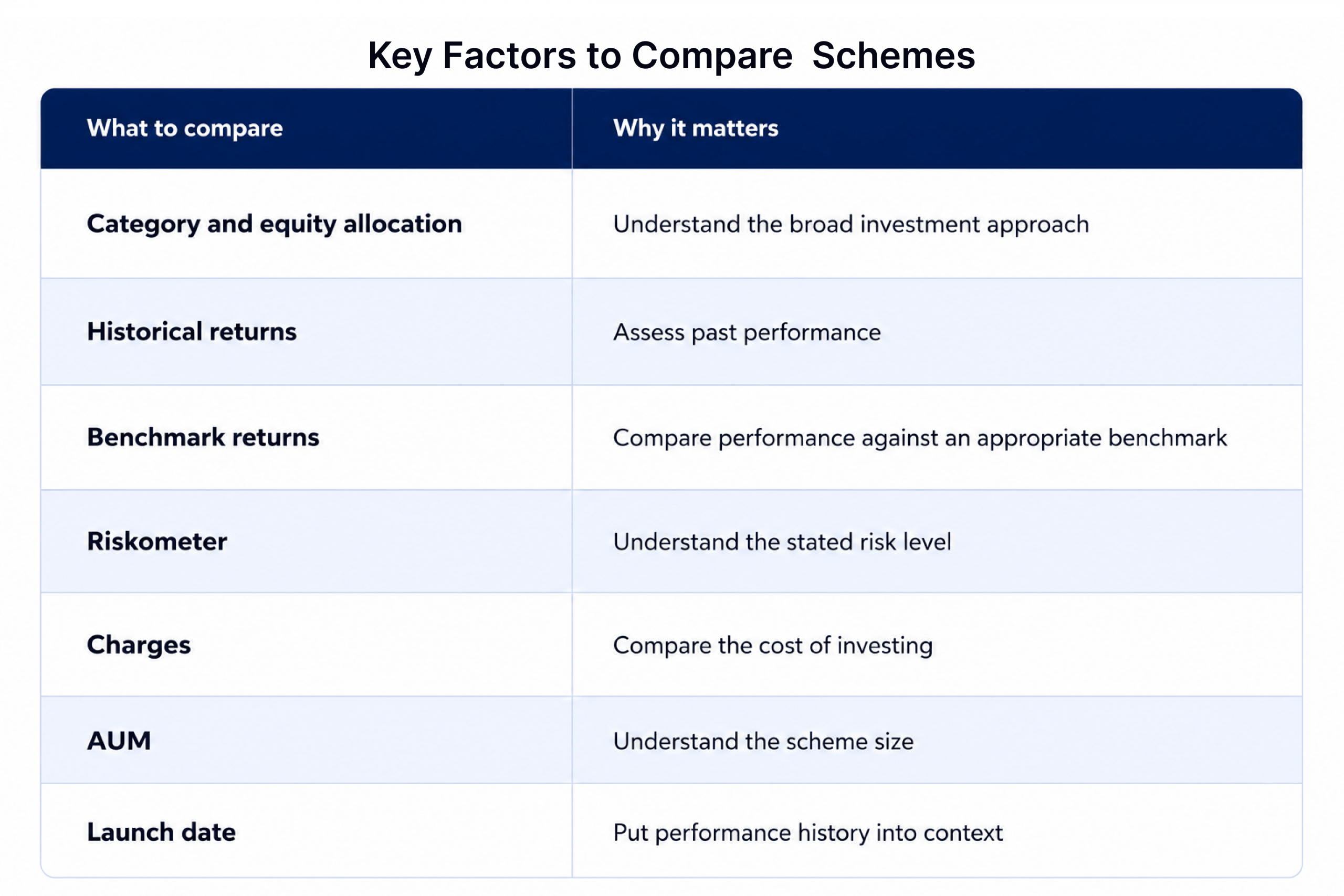
It is important to remember that two schemes within the same category will not necessarily perform similarly. Their portfolios, investment decisions and returns can still differ.
The benefit of standardisation is that investors now have a more meaningful basis for comparison.
What does this mean for NPS investors?
The new framework does not mean investors need to change their existing NPS investments. Instead, it provides a clearer framework for evaluating NPS investment options, particularly for those using MSF to build a diversified portfolio.
The first question can now be, “What kind of investment strategy do I want?” The next can be, “Which schemes within that category are worth comparing?”
This is a better way to approach NPS than simply searching for the fund with the highest recent return.
An investor can consider their age, retirement horizon, risk appetite and existing investments before deciding what role a particular scheme should play in their overall NPS portfolio.
The significance of the latest change, therefore, goes beyond standardising names.
MSF gave NPS investors more choice. Standardised categories give them a simpler way to navigate that choice.
As NPS evolves, investors can increasingly move from selecting a single “best NPS scheme” to thinking about how multiple schemes can work together to create a diversified retirement portfolio.
The information above is based on PFRDA’s standardised framework for classification and presentation of NPS schemes issued in August 2026. Investors should refer to the latest scheme documents and applicable disclosures before making investment decisions.
<hr>
Frequently Asked Questions About NPS MSF Scheme Categories
1. What are the new NPS MSF scheme categories for investors?
The new NPS MSF scheme categories provide a standardised way of classifying and presenting NPS schemes, making it easier for investors to understand the broad characteristics of different investment options. PFRDA introduced the Multiple Scheme Framework (MSF) for non-government sector subscribers in September 2025, allowing Pension Funds to design and offer multiple schemes under the NPS framework.
In August 2026, PFRDA introduced a standardised framework for the classification and presentation of NPS schemes, giving investors a more consistent way to understand and compare schemes. The classification is intended to make the broad investment characteristics of schemes easier to identify.
2. What is the Multiple Scheme Framework (MSF) in NPS and how does it work?
The Multiple Scheme Framework (MSF) allows eligible non-government NPS subscribers to invest in multiple schemes offered by Pension Funds, rather than being restricted to a single investment choice within a tier. It is designed to give subscribers greater flexibility to align their NPS investments with their retirement and wealth-building objectives.
Under the framework, Pension Funds can design schemes for different investor requirements and risk profiles. PFRDA’s MSF framework also allows schemes to be designed for specific subscriber groups, including corporate employees, self-employed professionals and platform-based workers.
Read the official PFRDA circular on the Multiple Scheme Framework for the regulatory details.
3. How are NPS schemes classified under the new MSF framework?
Under the new standardised framework, NPS schemes are classified and presented using common categories and terminology so that investors can more easily understand the broad characteristics of a scheme. The classification provides a common language for describing schemes rather than requiring investors to interpret every scheme name independently.
This is particularly relevant as the MSF framework has enabled Pension Funds to introduce a wider range of schemes with different investment strategies and risk characteristics.
The latest framework was issued by PFRDA in August 2026 through its Standardised Framework for Classification and Presentation of Schemes under NPS.
4. What do the different NPS MSF scheme categories mean for investors?
The categories are intended to give investors a quick understanding of the broad investment approach and risk characteristics of an NPS scheme. Instead of looking only at a scheme’s individual name, investors can use its standardised category as an initial reference point when comparing different options.
However, the category should be treated as a starting point rather than the only factor in an investment decision. Investors should also consider the scheme’s investment strategy, asset allocation, risk level, charges, track record and their own retirement objectives before making a choice.
5. How do NPS MSF scheme categories differ based on equity allocation?
Equity allocation is an important part of understanding the risk and growth characteristics of an NPS scheme. Under the MSF framework, Pension Funds can offer schemes with different investment approaches, including schemes with higher or lower equity exposure, subject to the applicable PFRDA investment framework.
For example, the MSF framework permits schemes to offer different risk variants, with equity allocation potentially going up to 100% for eligible schemes, subject to the applicable guidelines. This gives subscribers a broader range of investment approaches than the earlier NPS structure.
Investors should therefore look beyond the scheme name and examine the actual asset allocation and investment strategy before choosing an NPS scheme.
6. How can investors compare NPS schemes under the Multiple Scheme Framework?
The new classification can serve as the first filter when comparing NPS schemes. Investors can first look at the category and broad risk or investment characteristics, and then compare individual schemes within the relevant category.
Other factors to consider include the scheme’s asset allocation, investment strategy, risk profile, charges, benchmark and historical performance. The comparison should also take into account the investor’s retirement horizon, financial objectives and ability to tolerate investment fluctuations.
If you are new to NPS and want to understand the broader investment framework before comparing MSF schemes, you can also explore our guide on What Is Corporate NPS?.
7. What is the difference between NPS MSF scheme categories and Common Schemes?
NPS MSF scheme categories classify schemes based on their broad investment characteristics, such as equity exposure and risk profile. Common Schemes, on the other hand, are standard schemes with a common investment structure available across Pension Funds. In simple terms, the category helps investors understand what type of scheme it is, while a Common Scheme represents a standardised investment option within the NPS framework.
8. How does the new NPS MSF framework make it easier to compare NPS schemes?
The MSF framework has expanded the range of schemes available to eligible non-government subscribers. The subsequent standardisation of scheme classification and presentation is intended to make this wider choice easier to understand.
For investors, the benefit is that common categories and terminology can provide a more consistent starting point when comparing schemes offered by different Pension Funds. Instead of evaluating every scheme solely on its name or marketing description, investors can first understand its broad classification and then examine the underlying details.
The framework should therefore be viewed as a tool for making scheme information easier to interpret, rather than as a ranking of schemes.
9. Can NPS investors choose schemes from different MSF categories?
Under the Multiple Scheme Framework, eligible non-government NPS subscribers can invest in multiple schemes offered by Pension Funds. The framework was specifically introduced to provide greater flexibility and diversification within NPS.
Whether a particular combination of schemes is available can depend on the applicable NPS rules, the scheme structure and the subscriber’s account and tier. Investors should therefore check the applicable rules and scheme documentation before making changes to their investments.
The PFRDA MSF framework provides the underlying regulatory details.
10. Do existing NPS investors need to change their investment because of the new MSF scheme classification?
The introduction of standardised scheme classification does not by itself mean that every existing NPS investor needs to change their investment. The new classification is primarily intended to provide a common framework for presenting and understanding NPS schemes.
Existing subscribers should consider any investment change based on their own retirement objectives, investment horizon, risk profile and the specific features of the available schemes. They should also refer to the applicable PFRDA rules and scheme information before making a decision.
If you want to understand how NPS investments fit into a broader retirement strategy, you can also explore our content on NPS tax benefits and retirement planning.
11. Where can I learn more about the regulator and organisations overseeing NPS?
The National Pension System is regulated by the Pension Fund Regulatory and Development Authority (PFRDA). PFRDA is responsible for regulating and developing the pension sector and overseeing the NPS framework.
Subscribers can also refer to the NPS Trust for information, resources and updates relating to NPS. For official information, you can visit the PFRDA website and the NPS Trust website.
12. How can I open a Corporate NPS account through Floatr?
If your employer is empanelled with Floatr for Corporate NPS, you can open your Corporate NPS account directly through the Floatr mobile app in less than 5 minutes. The process is designed to make NPS onboarding simple and convenient for employees.
If you already have an existing NPS account, you can also apply to shift your existing NPS account to Corporate NPS through the Floatr app itself. The process can be completed in less than 2 minutes.
You can download the Floatr app on Android or iOS and get started.
The only requirement is that your employer should be empanelled with Floatr for Corporate NPS.