
For salaried employees, NPS tax benefits are often associated with the additional ₹50,000 deduction available for personal NPS contributions. But when NPS is offered through an employer, there is another tax benefit that can be considerably more valuable.
Under Corporate NPS, an employer can contribute to an employee’s NPS account. The employee can claim a deduction for the eligible employer contribution under Section 80CCD(2) of the Income-tax Act, 1961.
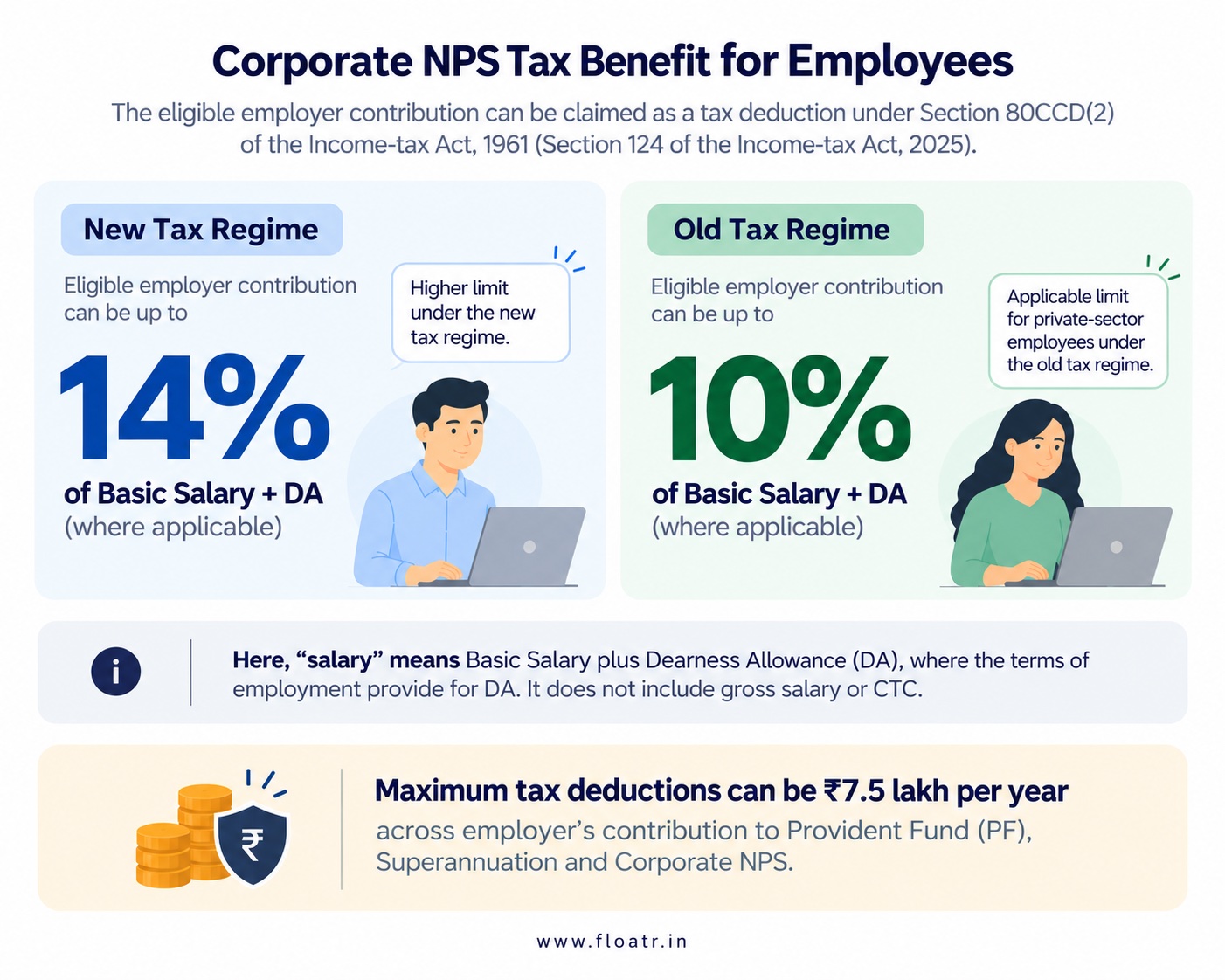
From 1 April 2026, the corresponding provision under the Income-tax Act, 2025 is Section 124. For employees covered under the new tax regime, an employer’s contribution to NPS can qualify for a deduction of up to 14% of salary, subject to the applicable tax regime.
This makes the tax benefit of Corporate NPS for employees particularly relevant for salaried professionals, especially those in higher tax brackets.
How does the Corporate NPS tax benefit work?
The important distinction is that this benefit relates to the employer’s contribution to NPS, rather than simply an employee putting their own money into an NPS account.
For employees in the private sector, Corporate NPS is often incorporated into the company’s flexible benefits or flexi-benefit structure. An employee may be given the option to allocate a portion of their compensation towards NPS. Once declared, the contribution can be processed through payroll and credited to the employee’s NPS account.
This makes Corporate NPS a form of payroll-linked investing. Instead of the employee having to separately invest every month, retirement investing becomes part of the salary and benefits process.
For the new tax regime, an employer’s eligible NPS contribution can be up to 14% of Basic Salary plus Dearness Allowance (DA), where applicable, while for employees under the old tax regime, the applicable limit is 10% of salary. Here, salary for this purpose does not mean gross salary or CTC; it generally refers to Basic Salary plus DA, where the terms of employment provide for DA.
How much tax can Corporate NPS save?
Consider an employee with:
- Annual gross salary: ₹30 lakh
- Basic Salary: ₹15 lakh
- Tax regime: New tax regime
- Eligible employer NPS contribution: 14% of Basic Salary
The maximum contribution eligible for deduction in this example would be:
₹15 lakh × 14% = ₹2.10 lakh per year
This ₹2.10 lakh can qualify for deduction under the employer-contribution provision, subject to the applicable conditions.
If the employee is in the 30% marginal tax bracket, the immediate income-tax saving would be:
₹2.10 lakh × 30% = ₹63,000
Adding the applicable 4% health and education cess:
Potential tax saving = ₹65,520 per year
So, an employee earning ₹30 lakh with a ₹15 lakh Basic Salary could potentially save ₹65,520 in tax every year by utilising the full 14% eligible employer NPS contribution.
This illustration assumes that the entire ₹2.10 lakh qualifies for deduction and that the employee is in the 30% marginal tax bracket. Actual tax savings will depend on the employee’s complete income, salary structure and applicable tax provisions.
What about the old tax regime?
The benefit is available under both tax regimes, but the applicable limit is different.
For employees of private-sector and other non-government employers, the employer NPS contribution is deductible up to 10% of salary under the old tax regime. Under the new tax regime, the limit increases to 14% of salary.
This makes Corporate NPS particularly interesting for employees who are already using the new tax regime. The employer contribution can provide a tax deduction even though many other Chapter VI-A deductions are not available under the new regime.
There is also an overall ₹7.5 lakh annual limit for the employer’s contributions to NPS, employer contribution to PF and approved superannuation fund, beyond which the excess contribution can have tax implications as a perquisite.
The tax saving is only the beginning
It is tempting to look at Corporate NPS simply as a way to reduce your income-tax bill. But there is a bigger reason to consider it.
The ₹2.10 lakh in our example is not merely a tax deduction on paper. It is being invested towards the employee’s retirement corpus.
If an employee receives an eligible ₹2.10 lakh annual NPS contribution for 20 years, that represents ₹42 lakh of contributions, before considering investment returns.
Over 25 years, the contributions alone would add up to ₹52.5 lakh.
The actual retirement corpus could be substantially higher depending on investment returns and the period for which the money remains invested.
This is what makes Corporate NPS tax benefits different from many conventional tax-saving decisions. The employee can potentially get an immediate tax benefit while simultaneously building a dedicated retirement corpus.
NPS offers tax advantages beyond the employer contribution
The employer contribution is therefore the biggest reason to look at Corporate NPS from a tax perspective. But it is not the only tax advantage offered by NPS.
NPS also provides tax efficiency during the investment journey. As we have explained in our detailed article on the Triple Tax Advantage of NPS, permitted portfolio rebalancing within NPS does not trigger capital gains tax. This allows an investor to change their asset allocation as their age, financial goals and risk appetite change without creating a capital-gains tax event.
The third advantage comes at exit. Under the current NPS framework, up to 60% of the accumulated corpus can be withdrawn as a tax-exempt lump sum at eligible normal exit, while the amount used to purchase an annuity at exit is also exempt from tax at the point of purchase. The subsequent annuity income is taxable when received.
These additional benefits matter because retirement investing is not a one-time transaction. It can span two or three decades. The ability to invest efficiently, manage the portfolio without capital-gains tax on permitted rebalancing, and receive favourable tax treatment at exit can add meaningful value over such a long period.
Why Corporate NPS deserves a closer look
The most important question for an employee should therefore not be “How much tax will I save this year?”
It should be:
“How much retirement wealth can I build while getting a tax benefit along the way?”
If your employer offers Corporate NPS through its flexible benefits programme, understand how much you are eligible to contribute and how the contribution will be treated within your salary structure.
The immediate benefit can be a lower tax outgo. The long-term benefit is the creation of a dedicated retirement corpus.
That combination makes Corporate NPS more than just a tax-saving option. It is a way to bring tax-efficient, payroll-linked retirement investing into your working life.
The tax saving is today’s benefit. The retirement corpus is tomorrow’s financial security.
Tax rules and NPS regulations may change. Employees should evaluate their individual salary structure, tax regime and applicable provisions before making investment decisions.