
Corporate NPS (National Pension System) is a way for employees to build retirement savings through NPS with the additional possibility of receiving contributions from their employer.
But there is often confusion about how Corporate NPS is different from an NPS account opened individually.
The important thing to understand is this:
Corporate NPS and Individual NPS are not two different investment products. They are two different ways of accessing the same NPS framework.
The investment choices, portfolio management flexibility and NPS account structure remain largely the same. The key difference is that when your NPS account is linked to your employer under the Corporate Sector, your employer can also contribute to your NPS account.
Let’s understand how it works.
Corporate NPS vs Individual NPS: What is the difference?
If you already have an NPS account or are considering opening one yourself, you may wonder whether joining your employer’s Corporate NPS program means getting a different type of NPS.
It doesn’t.
The underlying NPS framework remains the same.
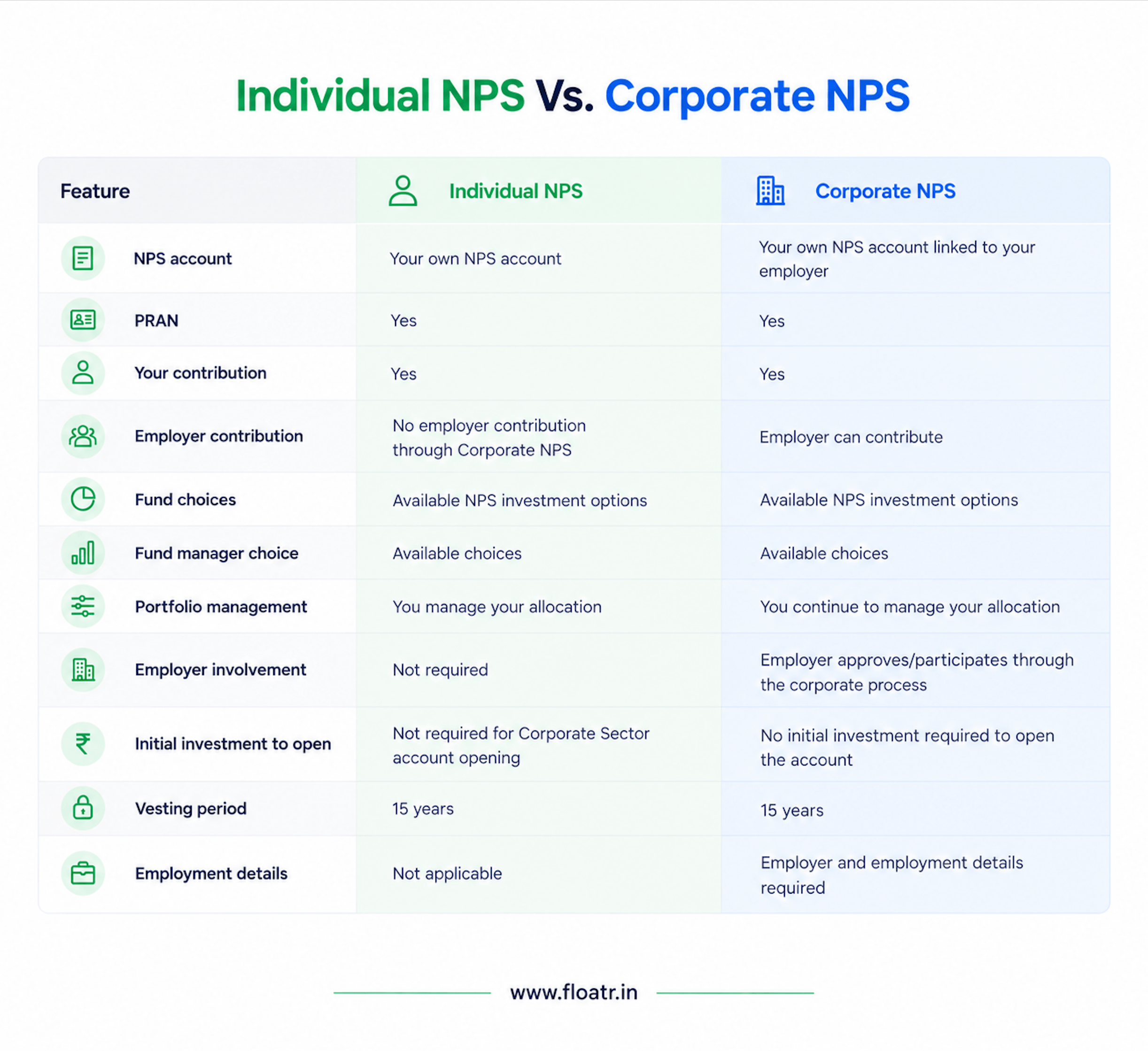
The biggest difference: your employer can contribute
The biggest advantage of being under the Corporate Sector is not a different set of investment options.
It is the ability for your employer to contribute to your NPS account as part of the company’s employee benefits or compensation structure.
For example, if your employer has enabled Corporate NPS and offers an NPS contribution as part of your compensation, that contribution can go directly into your NPS account.
Your own NPS contribution can continue alongside it.
This is what makes Corporate NPS particularly interesting for employees.
Do you lose any flexibility with Corporate NPS?
A common concern is whether moving your NPS account under the Corporate Sector means giving up control over your investments.
It doesn’t.
Corporate NPS does not create a separate investment product with restricted choices. Your NPS account continues to operate within the same NPS framework, and you retain the flexibility to manage your retirement portfolio based on the investment options available to you.
You can continue to make choices around:
- Investment schemes available under NPS
- Pension fund manager
- Asset allocation
- Your NPS portfolio
Your employer’s involvement does not mean that your employer decides where your NPS money is invested.
An important exception for government employees
The investment flexibility available under NPS can vary depending on the sector and applicable rules.
Employees covered under Central or State Government NPS structures may have certain restrictions or prescribed investment options that do not apply in the same way to Corporate Sector subscribers.
Corporate NPS is primarily designed for employees of organisations participating in the Corporate Sector, particularly private-sector employers. Being part of a Corporate NPS arrangement does not, by itself, mean giving up the investment flexibility available under the Corporate Sector framework.
So, what is the real difference between Individual and Corporate NPS?
The easiest way to think about it is: The NPS account is fundamentally the same. The key difference is who can contribute to it.
With Individual NPS, you open and contribute to your NPS account yourself.
With Corporate NPS, your NPS account is linked with your employer, allowing your employer to contribute to the account in addition to your own contribution.
Your PRAN, NPS portfolio, investment choices and fund manager choices continue to be part of your NPS account.
What happens if you change jobs?
Your NPS account does not belong to your employer.
It belongs to you.
So changing jobs does not mean you lose your NPS account or have to start over with a new PRAN. Your NPS savings remain yours.
If your new employer also offers Corporate NPS, your existing NPS account can be associated with the new employer’s Corporate Sector arrangement, subject to the applicable process.
If your new employer does not offer Corporate NPS, you can continue holding your NPS account independently.
This is one of the important differences between an employer-linked benefit and an employer-owned benefit: your NPS account stays with you.
Corporate NPS in a nutshell
Corporate NPS is best understood not as a different version of NPS, but as an employer-enabled way of participating in NPS.
You continue to have your own NPS account and PRAN. You continue to manage your NPS investments within the choices available to you.
The key additional feature is that your employer can also contribute to your NPS account when the organisation offers this benefit.
So if your employer offers Corporate NPS, it can be worth exploring—not because it changes how NPS fundamentally works, but because it can bring employer contributions and retirement savings together in the same NPS account.
Already have an NPS account? You may not need a new one. Your existing PRAN can potentially be moved to the Corporate Sector when your employer offers Corporate NPS.