Corporate NPS is the Corporate Model of the National Pension System, through which an employer can facilitate NPS for its employees and enable contributions through the workplace. Employees retain their NPS account while the employer becomes part of the contribution and administrative process.
Corporate NPS is an employer-facilitated way of participating in the National Pension System. It allows eligible employees to build retirement savings through NPS, with contributions that can be facilitated through the employer’s payroll process. Depending on the arrangement, the employer may also contribute to the employee’s NPS account.
It can complement existing retirement benefits such as EPF, gratuity and superannuation, while giving employees another structured way to build long-term retirement wealth.
How does Corporate NPS work?
Corporate NPS was introduced in 2011 to bring NPS into the organised sector. It is regulated by the Pension Fund Regulatory and Development Authority (PFRDA) and operates through a regulated ecosystem of pension fund managers, recordkeeping agencies and other intermediaries.
When a company adopts Corporate NPS, eligible employees can enrol and receive a Permanent Retirement Account Number (PRAN). The PRAN identifies the employee’s NPS account and stays with the subscriber through their working life.
The employer can decide how NPS will be incorporated into its benefits structure. For example, the company may make a defined contribution towards NPS as part of the employee’s compensation. Employees may also make their own contributions, depending on the company’s policy.
The contributions are invested in market-linked pension schemes selected by the employees themselves under the applicable NPS framework.
What is payroll-linked investing?
One of the important advantages of Corporate NPS is that retirement investing can become payroll-linked investing.
Instead of an employee having to remember to make a separate investment every month, the contribution can be integrated with the payroll and benefits process. This makes long-term investing more systematic and reduces the effort involved in managing retirement savings.
This is also why Corporate NPS can be particularly relevant for employers looking at payroll-linked employee benefits and corporate financial wellness.
For employees, it brings retirement saving into the same system through which they receive their salary and other benefits. For employers, it provides a structured way to offer a long-term financial benefit without having to create and manage their own pension investment infrastructure.
Who contributes to Corporate NPS?
Corporate NPS gives employers flexibility in deciding how contributions will work. A company can contribute to an employee’s NPS account, the employee can make their own contribution, or both can contribute.
In the private sector, one of the more common approaches is to offer the employer’s NPS contribution as part of the employee’s flexible benefits or flexi-benefit structure. Instead of treating NPS as an additional cost over and above the employee’s salary package, the employer can structure a portion of the employee’s overall compensation towards NPS, subject to the company’s policy and applicable tax rules.
For example, an employee may be offered the choice to allocate a specified portion of their salary or benefits towards NPS. Once the employee opts for it, the contribution can be processed through payroll and credited to the employee’s NPS account.
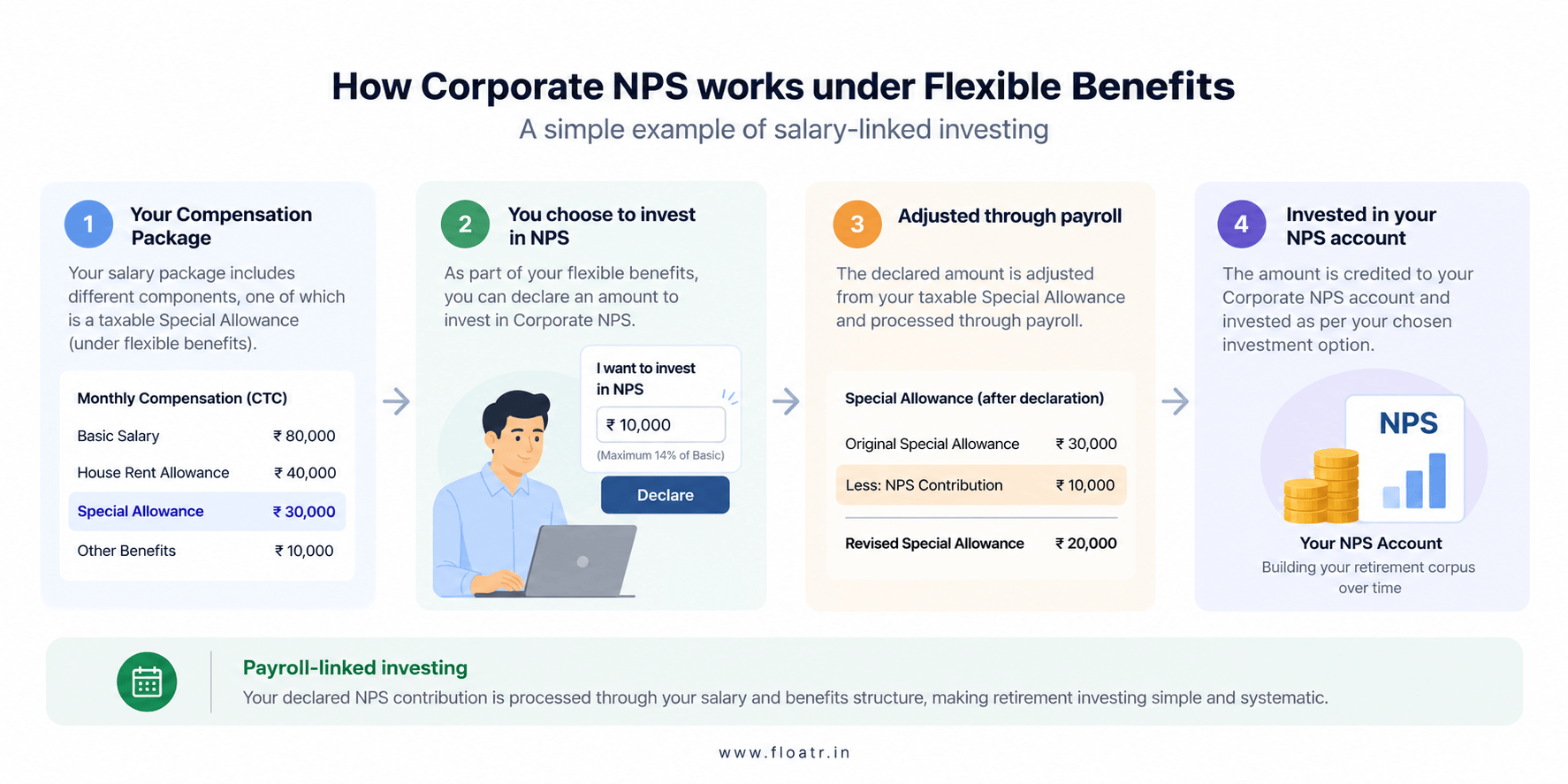
This creates what can be described as payroll-linked investing or salary-linked investing—where an investment happens alongside the salary process rather than requiring the employee to separately initiate it every month.
Some employers may also make an additional NPS contribution as an employee benefit. The exact structure can therefore vary from company to company. One organisation may offer NPS as a component of its flexible benefits, while another may provide an employer contribution as part of its compensation package.
For employees, this distinction is important. When NPS is offered through a flexible benefits structure, the employee should understand whether the contribution is coming from an existing component of their compensation or is an additional benefit provided by the employer. The tax treatment can also differ depending on how the contribution is structured.
This flexibility is one of the reasons Corporate NPS can fit naturally into modern employee-benefit programmes. It allows employers to incorporate retirement investing into the existing payroll and benefits architecture while giving employees a simple way to build their retirement corpus over their working years.
What are the investment options in NPS?
NPS is not a conventional fixed-return pension product. The contributions are invested in market-linked pension schemes.
Subscribers can choose how their retirement corpus is allocated across permitted asset classes and investment options under the NPS framework. These can include equity, corporate debt and government securities, depending on the applicable scheme and investment choice.
This means an employee can build an NPS portfolio based on their investment horizon, financial goals and risk appetite.
The NPS framework has also evolved over time, giving non-government subscribers greater choice in selecting investment schemes. This makes it possible to look at NPS as part of a broader retirement planning strategy rather than simply as a pension account.
What are the tax benefits of Corporate NPS?
Tax benefits are an important part of the Corporate NPS proposition.
Employer contributions to NPS can qualify for a tax deduction under Section 80CCD(2) of the Income Tax Act, subject to the applicable conditions and limits. Under the Income Tax Act, 2025, the corresponding provision is covered under Section 124.
The actual tax benefit available to an employee depends on factors such as their salary structure and the amount contributed by the employer. Importantly, the tax benefit on eligible employer contributions to NPS is available under both the old and new tax regimes, subject to the applicable limits and conditions.
NPS also has a significant triple tax benefit across the investment journey—covering the tax treatment of contributions, switching or rebalancing within NPS, and the applicable treatment at exit.
Employees should, however, evaluate the tax benefit based on their own salary structure and applicable tax provisions rather than assuming that every contribution receives identical tax treatment.
Corporate NPS can offer significant tax advantages, particularly where the employer contributes to an employee’s NPS account. The applicable tax treatment depends on the contribution structure and the tax regime chosen by the employee. To understand the tax benefits of NPS in greater detail, read our guide on NPS Tax Benefits: The Triple Tax Advantage. You can also read this Financial Express article on the triple tax advantage of NPS for an independent perspective.
Corporate NPS vs Individual NPS
The underlying NPS framework is broadly the same, but the way the account is accessed is different.
With individual NPS, a person opens and manages the account independently and makes contributions directly.
With Corporate NPS, the employer first adopts NPS for its employees. Employees can then enrol through the organisation, with contributions potentially being integrated with the company’s payroll and benefits process.
Your NPS account travels with you, not with your employer. Changing jobs does not mean withdrawing your accumulated NPS corpus or opening a new PRAN. Your existing NPS account continues with you as you move from one employer to another, subject to the applicable process.
Corporate NPS and Individual NPS are built on the same NPS framework, but they differ in how the account is connected to the employer, how contributions can be made and the role of the employer in the process. To understand the key differences in detail, read our guide on Corporate NPS vs Individual NPS: Key Differences.
Why should employers offer Corporate NPS?
For employers, Corporate NPS can be more than another investment option. It can become part of a company’s broader employee financial wellness strategy.
Retirement is one of the largest long-term financial goals for most employees, but it is often postponed because it competes with immediate financial priorities. Making retirement saving part of the workplace benefits structure can help employees start earlier and invest more consistently.
For the employer, a Corporate NPS platform or Corporate NPS service provider can help simplify implementation, employee onboarding, contribution processing and ongoing administration.
For employees, the benefit is equally straightforward: a dedicated retirement investment that can receive regular contributions throughout their working life, potentially including contributions from their employer.
Ultimately, Corporate NPS brings retirement planning into the workplace. It combines the convenience of payroll-linked investing with the long-term investment framework of NPS, while providing employers with a structured retirement benefit to support their employees’ financial security.
Frequently Asked Questions About Corporate NPS
1. What is Corporate NPS and how does it work for employees?
Corporate NPS is the employer-enabled version of the National Pension System (NPS), through which employees can make retirement-oriented investments as part of their workplace benefits. Depending on the structure adopted by the employer, contributions can be made through payroll, and eligible employer contributions may also qualify for tax benefits under the applicable provisions.
To understand the concept in more detail, read our guide on What Is Corporate NPS?. You can also explore our step-by-step guide on How Does Corporate NPS Work?.
2. What are the benefits of Corporate NPS for employees?
Corporate NPS can provide employees with a structured way to build retirement savings through payroll-linked contributions. Depending on the employee’s circumstances and applicable tax rules, NPS can also provide tax benefits, while the accumulated pension wealth remains linked to the employee’s PRAN.
Employees can explore the broader advantages of the National Pension System in our guide to NPS Tax Benefits: The Triple Tax Advantage.
3. Can an employer contribute to an employee’s Corporate NPS account?
Yes. An employer can contribute to an employee’s NPS account under the Corporate Model, subject to the structure of the employer’s NPS programme and the applicable rules. Eligible employer contributions can provide tax benefits to the employee under the applicable provisions of the Income Tax law.
The tax treatment depends on factors such as the contribution structure and the tax regime applicable to the employee. For a detailed explanation, read our guide on NPS Tax Benefits: The Triple Tax Advantage.
4. How is Corporate NPS different from Individual NPS?
Corporate NPS and Individual NPS operate within the same NPS framework, but they differ in how the account is connected to the employer, how contributions can be made and the role of the employer in the process.
To understand the key differences in detail, read our guide on Corporate NPS vs Individual NPS: Key Differences.
5. What are the tax benefits of Corporate NPS for employees?
Corporate NPS can offer significant tax advantages, particularly where the employer contributes to an employee’s NPS account. The applicable tax treatment depends on the contribution structure and the tax regime chosen by the employee.
To understand the tax benefits of NPS in greater detail, read our guide on NPS Tax Benefits: The Triple Tax Advantage. You can also read this Financial Express article on the triple tax advantage of NPS for an independent perspective.
6. Can I join Corporate NPS if my employer offers it?
If your employer has enabled the Corporate NPS facility, eligible employees can generally enrol through the process established by the organisation. The employer’s payroll and NPS onboarding process determines how the employee registration and contribution process is completed.
For a step-by-step explanation of the process, read How Does Corporate NPS Work? A Step-by-Step Guide for Employees.
7. Do I need a new PRAN for Corporate NPS if I already have an NPS account?
No. An existing NPS subscriber generally continues with the same Permanent Retirement Account Number (PRAN). The PRAN identifies the subscriber’s NPS account, and an employee does not normally need a separate PRAN simply because they move into a Corporate NPS arrangement.
If you are already an NPS subscriber and are moving between employers or NPS models, the specific process can depend on the circumstances. Our guide on How Does Corporate NPS Work? explains the process in greater detail.
8. What happens to Corporate NPS when I change jobs?
Changing employers does not by itself mean that your accumulated NPS wealth is liquidated or that your PRAN is reset. Your NPS account remains associated with your PRAN, although the way future contributions are made can change depending on the NPS arrangement offered by your new employer.
If your new employer also offers Corporate NPS, the process for continuing contributions through the new employer may need to be completed as part of the onboarding process.
9. How can employers introduce Corporate NPS for employees?
Employers can introduce Corporate NPS as part of their employee benefits or flexible benefits framework. The implementation involves establishing the appropriate NPS arrangement, completing the required onboarding and registration processes, and integrating employee contributions with payroll where applicable.
Employers can also explore Floatr’s Corporate NPS solution to understand how a payroll-linked NPS programme can be implemented for employees.
10. What is “NPS vs Mutual Funds: The Decision That Could Boost 60% of Your Retirement Income”?
NPS and mutual funds can serve different purposes within a retirement portfolio. NPS is specifically designed for retirement planning and can offer applicable tax benefits, while mutual funds can provide greater flexibility in terms of investment objectives and access to invested money. The right approach depends on an individual’s retirement goals, time horizon, risk profile, liquidity requirements and overall financial plan.
You can read more about this comparison in the NPS vs Mutual Funds: The Decision That Could Boost 60% of Your Retirement Income article on Moneycontrol.
You can also explore Floatr’s guide on NPS Tax Benefits: The Triple Tax Advantage to understand the tax treatment of NPS in greater detail.
11. Where can I learn more about the regulators and organisations overseeing NPS?
The National Pension System is regulated by the Pension Fund Regulatory and Development Authority (PFRDA), which is responsible for regulating and developing the pension sector and overseeing the NPS framework. Subscribers can also refer to the NPS Trust for information and resources relating to NPS and subscriber interests.
For official information, you can visit the PFRDA website and the NPS Trust website.
12. How can I open a Corporate NPS account through Floatr?
If your employer is empanelled with Floatr for Corporate NPS, you can open your Corporate NPS account directly through the Floatr mobile app in less than 5 minutes. The process is designed to make NPS onboarding simple and convenient for employees.
If you already have an existing NPS account, you can also apply to shift your existing NPS account to Corporate NPS through the Floatr app itself. The process can be completed in less than 2 minutes.
You can download the Floatr app on Android or iOS and get started.
The only requirement is that your employer should be empanelled with Floatr for Corporate NPS.
12. How can I open a Corporate NPS account through Floatr?
If your employer is empanelled with Floatr for Corporate NPS, you can open your Corporate NPS account directly through the Floatr mobile app in less than 5 minutes. The process is designed to make NPS onboarding simple and convenient for employees.
If you already have an existing NPS account, you can also apply to shift your existing NPS account to Corporate NPS through the Floatr app itself. The process can be completed in less than 2 minutes.
You can download the Floatr app on Android or iOS and get started.
The only requirement is that your employer should be empanelled with Floatr for Corporate NPS.