goes into choosing a Pension Fund Manager, selecting an investment option and deciding how much of their contribution should go into equity.
For someone with 15–20 years or more until retirement, the initial asset allocation decision can have a significant impact on the eventual retirement corpus. A higher allocation to equity can help investors participate in long-term market growth, although it also comes with greater short-term volatility.
However, there is another important aspect of retirement investing that often receives less attention: knowing when to change your asset allocation, when to reduce risk and when to start planning your exit from investments.
Investing is only half the job. Knowing when to rebalance and eventually redeem is equally important.
Your NPS investment strategy should not remain static throughout your working life. It should evolve as you move closer to retirement.
Let’s understand how to approach NPS asset allocation at different stages of your investment journey.
Why Should You Start Your NPS Journey with Higher Equity Exposure?
One of the biggest advantages of starting retirement investments early is the time available for your investments to grow.
Equity investments have historically offered the potential for higher long-term returns compared with relatively conservative fixed-income investments. However, they also experience greater fluctuations and can go through periods of market decline.
For someone who has 15–20 years or more until retirement, these short-term market movements may be less concerning than they would be for someone approaching retirement.
This is why investors with a longer investment horizon may consider starting their NPS journey with a relatively higher allocation to equity.
Should You Consider 75% or More in Equity?
If you have a long investment horizon and can tolerate market volatility, an equity allocation of 75% or higher, wherever permitted under the applicable NPS investment framework, may provide a stronger opportunity to participate in long-term market growth.
For investors who are uncomfortable with higher market fluctuations, an equity allocation of around 50% can also be a reasonable starting point. It allows meaningful participation in equity market growth while keeping a larger portion of the portfolio invested in relatively less volatile asset classes.
The right allocation will depend on your age, investment horizon, risk tolerance and financial circumstances. Higher equity exposure does not guarantee higher returns, and investors should be prepared for periods of market volatility.
The important point is not that everyone must choose the most aggressive option. It is that investors with a sufficiently long investment horizon should understand the opportunity cost of being excessively conservative from the beginning.
Understand Your NPS Investment Choices Before Deciding Your Allocation
NPS offers different investment choices that allow subscribers to determine how their contributions are invested across asset classes.
For non-government subscribers, the broad investment frameworks include the Common Schemes and the Multiple Scheme Framework (MSF).
Under the Common Scheme, subscribers can choose between:
Active Choice: You decide how your contributions are allocated across the available asset classes, subject to the applicable investment limits. This option gives you greater control but also requires you to review and manage your allocation periodically.
Auto Choice: Your investments are allocated automatically according to a lifecycle-based strategy. The equity allocation reduces as you grow older, based on the selected lifecycle option. This may suit investors who prefer not to manage their asset allocation actively.
The Multiple Scheme Framework provides additional investment choices, including more aggressive schemes that may allow higher equity exposure, with higher market risk.
The choice between these options should depend on how actively you want to manage your investments and how much market risk you are comfortable taking.
An investor who understands asset allocation and is willing to review investments periodically may prefer Active Choice or an appropriate MSF option. Someone who prefers a more automated approach may find Auto Choice more suitable.
The key is to understand the investment framework rather than selecting an option simply because it offers the highest possible equity exposure.
If you are new to NPS, you can also read our detailed guide on Corporate NPS and how it works for employees and employers.
Don’t Treat NPS as a Set-It-and-Forget-It Investment
A common mistake in long-term investing is to assume that once an investment decision has been made, it does not need to be reviewed until the goal is reached.
This approach may work for certain investment products, but retirement investing requires a more thoughtful approach.
Consider two investors.
The first starts investing in NPS at age 30 with 75% equity exposure. The second starts with 50% equity exposure because of a relatively lower risk appetite.
Both investors may have made reasonable initial decisions based on their circumstances.
However, should either of them continue with exactly the same asset allocation until retirement?
Not necessarily.
A 75% equity allocation may be suitable when retirement is 20 years away, but the same allocation may expose the accumulated retirement corpus to considerable market risk when retirement is just a few years away.
Similarly, even an investor who starts with 50% equity should not assume that the original allocation will remain appropriate throughout the investment journey.
Your NPS asset allocation should evolve with your investment horizon, not remain frozen at the allocation you selected when you opened your account.
This is why reviewing your portfolio periodically is important, particularly as you approach retirement.
You can also understand what difference asset allocation can make to your portfolio through our detailed guide, which explains how asset allocation and permitted NPS switches can influence long-term investment outcomes.
Start Reviewing Your NPS Portfolio at Least Five Years Before Retirement
One of the most important stages of retirement planning begins approximately five years before your planned retirement date.
At this stage, the focus should gradually shift from maximising portfolio growth to protecting the retirement wealth you have accumulated.
Imagine that you have built a substantial NPS corpus over 20–25 years. A significant market correction just one or two years before retirement could affect the value of your accumulated investments.
The challenge is that you may not have enough time to recover from such a decline before you need to start using the money.
This is where NPS rebalancing becomes important.
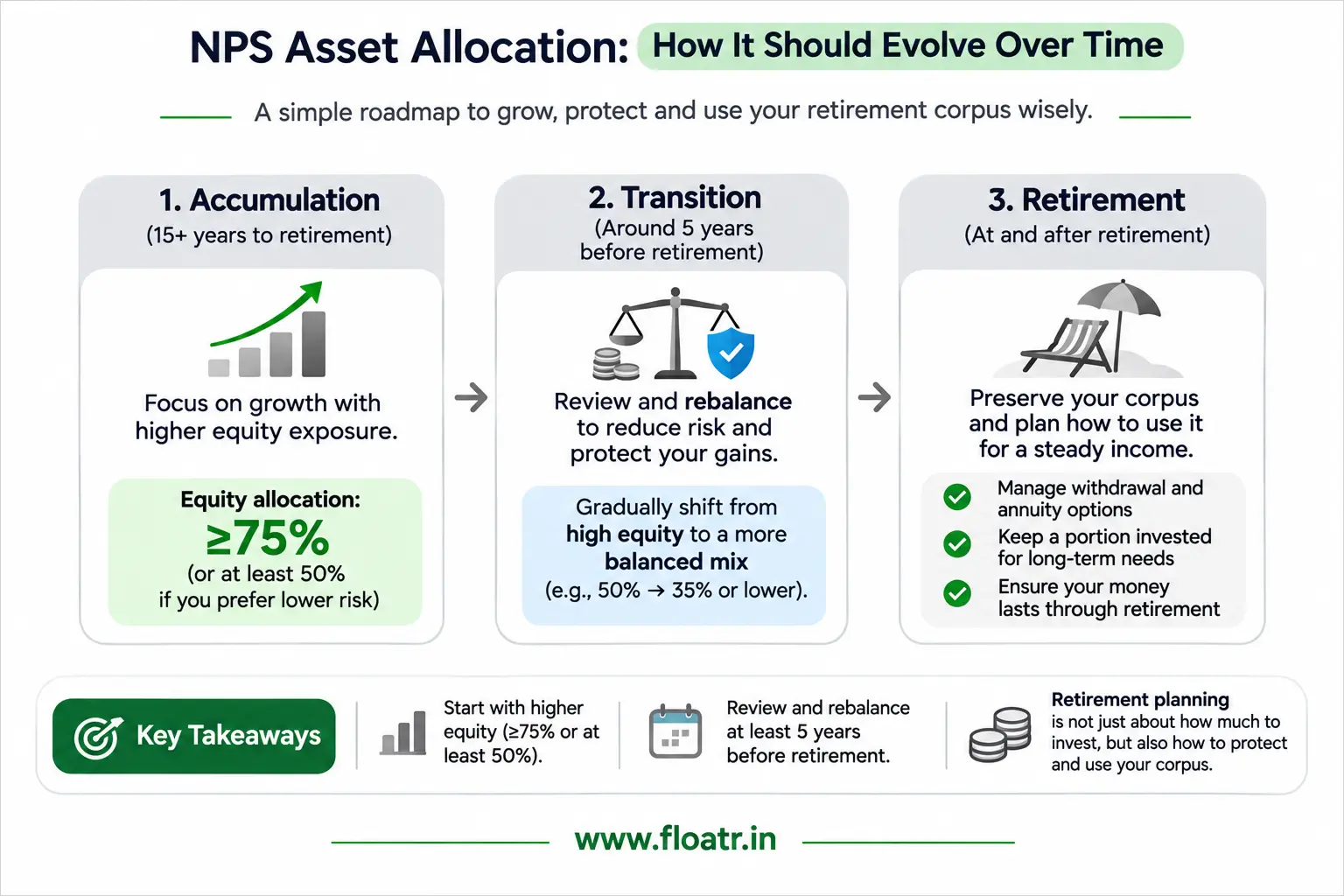
Investors who have maintained a relatively high equity allocation may consider gradually reducing their exposure as retirement approaches. For example, someone who has maintained 75% equity exposure may gradually move towards 50%, 35% or even lower, depending on their circumstances and the applicable investment options.
For investors using aggressive MSF schemes with higher equity exposure, reviewing the allocation and planning an appropriate transition becomes even more important.
This does not mean that every investor must follow a fixed allocation or reduce equity at the same rate. The right approach depends on the size of the retirement corpus, expected retirement expenses, other sources of income and the individual’s risk tolerance.
The objective is to avoid taking unnecessary market risk with money that may soon be required for retirement.
In my recent article for Financial Express, I have explored why NPS investors should reconsider their asset allocation as retirement approaches, including the risks of maintaining very high equity exposure close to the planned exit date.
Read: Why Your NPS Asset Allocation Strategy Must Evolve with Age – Financial Express
Why NPS Rebalancing Matters as Retirement Approaches
NPS rebalancing is not simply about changing investments whenever the market moves. It is about ensuring that your portfolio continues to reflect your investment objectives and risk tolerance.
Suppose you have maintained a high equity allocation throughout your working years. As retirement approaches, you may want to gradually shift a portion of your investments towards relatively stable debt-oriented asset classes.
This can help reduce the impact of a sudden equity market correction on your overall retirement corpus.
Consider a simple illustration.
If your portfolio has an equity allocation of 75% and the equity component experiences a 15% decline, the overall impact on your portfolio could be significant, even if the remaining investments are relatively stable.
More importantly, a market decline close to retirement leaves less time for your portfolio to recover.
For example, a 15% fall in portfolio value requires approximately 17.6% growth just to return to the original value.
This is why the final few years before retirement deserve as much attention as the accumulation years.
However, reducing equity exposure also involves a trade-off. Markets may continue to rise after you reduce your allocation, and you may miss out on some potential returns.
Rebalancing is therefore not an attempt to predict market movements. It is a way to manage risk and align your portfolio with the changing needs of your retirement journey.
There is also an important tax consideration. One of the advantages of NPS is that permitted switches between asset classes do not trigger capital gains tax merely because the portfolio is rebalanced. This gives subscribers flexibility to review and adjust their allocation without the same capital-gains tax implications that may arise when selling investments in other investment structures.
For a deeper understanding of this benefit, read our article on the triple tax advantage of NPS, which explains the tax efficiency available across the contribution, investment and withdrawal stages of NPS.
Retirement Planning Is Also About Planning Your Exit
Most retirement calculators and investment discussions focus on one central question:
How much money do you need to accumulate before retirement?
While this is important, it is only one part of the retirement planning equation.
You must also consider:
- How will you protect the corpus you have accumulated?
- How much of your retirement wealth should remain invested for potential future growth?
- How much money will you need immediately after retirement?
- How will you generate a regular income from your accumulated retirement wealth?
- How will you manage withdrawals so that your money lasts throughout retirement?
These questions highlight an often-overlooked aspect of financial planning: the exit strategy.
Your investment journey does not end when you reach your retirement goal. In fact, that is when a different phase of financial planning begins.
For NPS subscribers, this also means understanding the applicable exit and withdrawal rules, including the options for lump-sum withdrawal and annuity purchase. These rules and available choices should be reviewed well in advance rather than being considered only when retirement arrives.
The right retirement strategy must therefore account for both the accumulation phase and the withdrawal phase.
A well-built corpus is important. But protecting it and using it efficiently over the next 20–30 years may be an even bigger challenge.
I have explored this broader idea in my earlier article for Mint, where I explain why an investment plan is incomplete without a clear exit strategy.
Read: Why Your Investment Plan Is Only Half Complete Without an Exit Strategy – Mint
Make Your NPS Asset Allocation a Continuous Part of Retirement Planning
NPS offers flexibility through different investment choices and asset allocation options. However, that flexibility is useful only when subscribers understand how and when to use it.
A sensible approach is to think about your NPS investment journey in three broad stages:
Stage 1: Accumulation – Focus on Long-Term Growth
When retirement is more than 15 years away, consider an equity allocation suited to your risk appetite and investment horizon. Avoid becoming excessively conservative simply because of short-term market volatility.
Stage 2: Transition – Gradually Review and Reduce Risk
Approximately five years before retirement, begin reviewing your NPS asset allocation more closely. Assess whether your current equity exposure remains appropriate and consider gradually shifting towards a more conservative allocation.
Stage 3: Retirement – Protect and Utilise Your Corpus
As retirement approaches and after you retire, focus on protecting your accumulated wealth, understanding NPS exit options and planning how to use your retirement savings to meet your future expenses.
The exact allocation and transition strategy will differ from one individual to another. There is no single formula that works for everyone.
What matters is that your investment strategy evolves with your life stage.
Conclusion: Investing Is Only Half the Job
Building a retirement corpus requires discipline, consistency and time. But reaching your retirement goal is not just about investing regularly or choosing the right asset allocation at the beginning.
It is equally about knowing when to rebalance, when to reduce risk and how to plan your exit from investments.
A strategy that works when you are 30 may not be appropriate when you are 55. Your investment horizon changes, your financial priorities evolve and your ability to absorb market volatility may also change.
This is why NPS asset allocation should never be treated as a one-time decision.
Investing is only half the job. Knowing when to rebalance, protect and eventually redeem your investments is equally important.
At Floatr, we believe retirement planning should go beyond estimating how much you need to save. It should also help you understand whether you are on track, how to protect your accumulated wealth and how to prepare for life after retirement.
Because a financially secure retirement is not just about how much you accumulate. It is also about how well you manage and utilise what you have built.
Disclaimer: This article is for general educational purposes only and should not be treated as investment advice. NPS investments are market-linked and returns are not guaranteed. Equity allocation and investment choices should be based on an individual’s age, financial goals, investment horizon and risk tolerance. NPS investment limits, scheme features and exit rules are subject to applicable PFRDA regulations and amendments.
Further Reading: Published Media Articles
For more insights on NPS investment strategy, asset allocation and retirement planning, you may also read my articles published in leading financial publications:
1. Why Your NPS Asset Allocation Strategy Must Evolve with Age – Financial Express
Understanding why NPS investors should gradually review their equity exposure and protect their accumulated retirement corpus as they approach retirement.
2. Why Your Investment Plan Is Only Half Complete Without an Exit Strategy – Mint
Why successful investing is not just about building wealth, but also knowing when and how to exit your investments.